Admin_Adham
 Jump to Key Points
 As a child, Nathan Gray, MD, dreamt that he’d grow up to become Batman or at least a superhero cartoonist. Instead, he traded his sketchbooks for textbooks and went to medical school. Life as an early-career doctor, however, didn’t extinguish his need to make art — it just gave him more stories to tell.
During a keynote speech at the Graphic Medicine 2026 Conference in Baltimore, Gray recalled finding himself, “swirling into this tunnel of diagnoses, tests, labs, learning about the science. But something was missing, and I got aggressively bored or burnt out. So I started doodling late in my residency again because I had a little bit of free time and a lot to say.”
Over the 3-day conference, Gray, now a palliative care physician and associate professor of medicine at the Johns Hopkins University in Baltimore, and more than 200 other attendees shared how graphic medicine — the use of comics in healthcare discourse — can help patients and clinicians convey medical information and bring attention to often overlooked conditions or experiences. Combining data, art, and dialogue, Gray has used comics to debunk public misconceptions about cardiopulmonary resuscitation, explore the changing economic landscape of hospice care, and discuss the complexities of end-of-life planning (this one hits particularly hard).
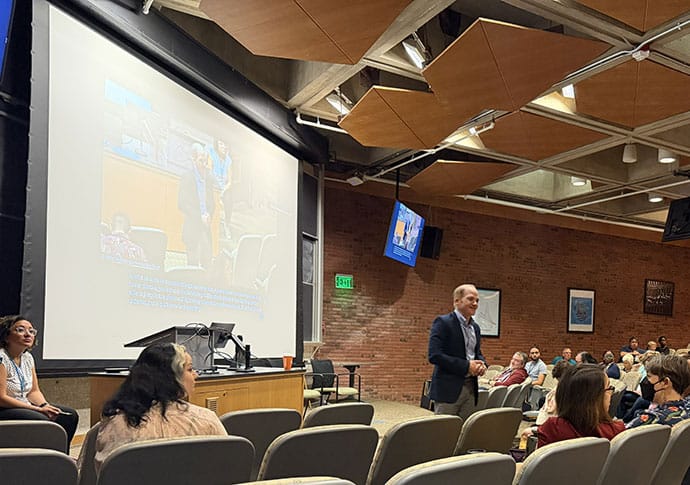
“Art has always had the capacity to transform,” conference co-organizer Benjamin Schwartz, MD, told Medscape Medical News. Schwartz is an assistant professor of medicine (in surgery) at Columbia University in New York City, and co-director of the Narrative Medicine StudioLab — and a staff cartoonist for The New Yorker. “When applied to healthcare, it can provide clarity and it can expose complexity. When communicated through the comic form and its parallel streams of words and pictures, it often does both at once.”
- Graphic medicine = comics to improve clinician-patient communication + understanding.
- Narrative art helps physicians process burnout, moral distress, difficult cases.
- Comics can explain CPR, hospice economics, end-of-life planning, chronic pain.
- Visual storytelling may improve empathy, retention, and patient-facing education.
- Challenges: info density, anxiety risk, AI impact, clinician skepticism.
The conference’s theme, “Drawing Perspectives: Health Graphic Narratives Under Pressure,” centered on the many pressures — political, ethical, moral, and economic — that affect healthcare systems and patients today.
“At a time when our world feels more confusing than ever and our collective health more fragile, the work done by the Graphic Medicine community helps us make sense of difficult experiences, recognize new perspectives, and consider more human ways of caring for each other,” said Schwartz.
Throwing Light on the Dark Moments
Drawing has helped Gray process some of his worst moments in medicine, including patients for whom he wishes he could have done more. His graphic narrative “Cruel Carousel” tells the story of a man, Silvio, that he treated in residency. Silvio, a roofer about the same age as Gray at the time, had severe kidney failure.
“I remember feeling crestfallen when he showed up to my outpatient clinic with the dialysis catheter in his upper neck the first time, because I knew what dialysis meant for someone like Silvio who was undocumented in Texas at that time,” Gray shared during his address.
Because of his immigration status, Silvio couldn’t access outpatient dialysis, only emergency care once his condition turned life-threatening. He came to the emergency department every week or two for dialysis until one day, in the last year of Gray’s residency, Silvio stopped showing up. He had died at another hospital when he sought dialysis but couldn’t get to the machine in time.
“Years afterward, Silvio’s story still shakes me,” Gray wrote in “Cruel Carousel” alongside a drawing of his own hand loosely clutching a stethoscope, depicting the powerlessness and hopelessness he felt. “I often think about the cruelty of his last months and final hours.”
For Gray, cartoons are an accessible medium to raise awareness about moral and economic dilemmas in medicine.
“I think graphic medicine has such a wonderful power to bridge,” he told his audience “to take different people with different levels of training, different types of experience, people with no training at all, and give them the power, the tools to connect.”
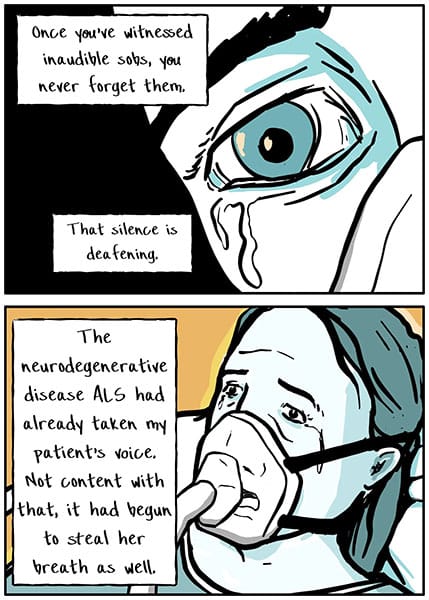
Thinking in terms of story also helps him listen to patients more attentively, he said.
“Even a patient coming to your clinic for the first time and telling you what’s wrong with them, what bothers them, what hurts, is a story. And in its best form, medicine should be a story-receiving practice, a story-processing practice, and story-interpretation process. Because the process of making a diagnosis should never be just a checklist but should be an understanding of who this patient is, what their illness means to them, what treatments matter to them.”
Gray is the author of a forthcoming graphic memoir, The Human Remains — Drawing Out Compassion in Medicine, which details his journey through medical training and practice, and how he reached a greater understanding of patient stories.
‘I Used to Be Such a Good Writer’
Even for doctors who don’t consider themselves artistically inclined, dabbling in graphic medicine can help them communicate their ideas, an important step toward making systems better. After joining the University of Virginia School of Medicine in Charlottesville, Monique DuFour, PhD, director of faculty development, started noticing a common refrain from physicians. “I used to be such a good writer,” they would say. “I don’t know what happened to me.”
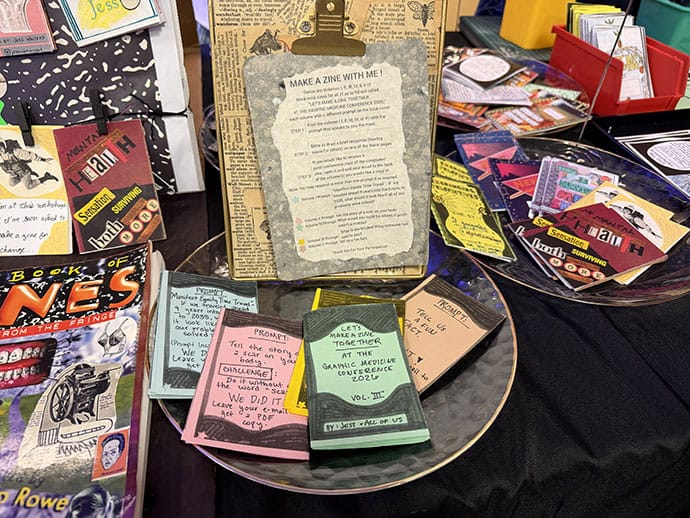
Her team started developing writing programs that included visual art. “How can you use drawing as a thinking and iterative tool to get you out of productivity mode and get you back into a kind of open-minded, generative mode, and then how do you write for different publics and disseminate that work in ways that are outside of the exceedingly slow and often painful peer review system?” DuFour asked the audience during a conference session on graphic medicine in universities and medical schools.
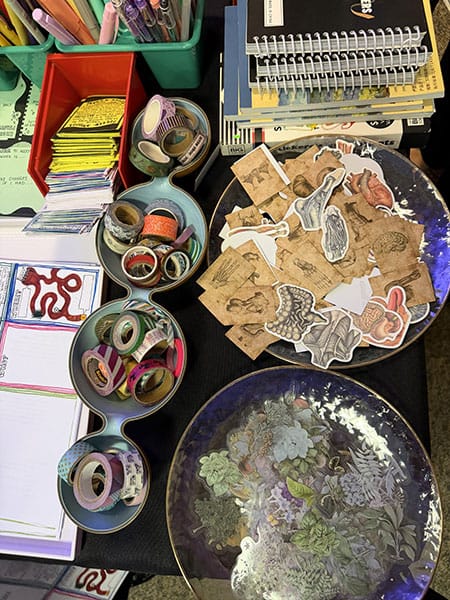
The answer, in her programming, includes stickers. With help from artist-in-residence Jess Walters, DuFour’s team engages medical school faculty in creative workshops, including zine-making sessions complete with markers for drawing and a sticker buffet that makes even seasoned doctors open up.
Doctors-in-training can also benefit from drawing cartoons. Throughout the conference, many medical students and residents said that drawing helps them cope with the demands of their training, empathize with patients, and develop a deeper understanding of the emotional struggles and cultural nuances of patient care.
In a 7-minute presentation about her work, Iris Kim, a medical student at the Miller School of Medicine, University of Miami in Miami, shared a graphic narrative that explored chronic itch and cultural identity. Drawing from the lived experience of second-generation immigrants navigating ongoing treatment for eczema and other skin conditions, she found a story arc that deepened her empathy and curiosity in her field of interest: dermatology.
“With chronic conditions, there is often no happy ending,” she said.
Speaking to Patients and Beyond
For the people who make graphic medicine, the labor and joy of creative expression, and the lessons learned along the way, have benefits of their own. When their work reaches patients, caregivers, and the public, the impact can multiply.
Sometimes the best ideas come from patients themselves, who can draw upon their personal experience to tell informative, entertaining stories that land with people going through the same challenges. Author Jen Leach, MA, MS, wrote a graphic book, From TMJ to OMG: Comics to Make Invisible Jaw Pain Impossible to Ignore, after her four-decade struggle with temporomandibular joint dysfunction reached a breaking point.
“I cracked a tooth while wearing my nightguard,” she shared during a presentation about her work. “That’s how stressed I was.”
With help from Maya Youness, DDS, an assistant professor in the Department of Oral and Maxillofacial Surgery at College of Dental Medicine, Columbia University, who specializes in orofacial pain, Leach created a comic book that follows the journey of “Mr. Tooth,” her cracked tooth.
Over 6 months of writing, sketching, reviewing research, and consulting with Youness, Leach packed the book with facts she wished she had known earlier about TMJ, such as how many times the jaw opens and closes per day (thousands), how joint disorders contribute to widespread musculoskeletal pain, and how siloed medical care can cause treatment delays for people — often women — with jaw pain. While temporomandibular joint disorders are common, qualitative research suggests many patients struggle for years or even decades without getting the help they need.
While sharing medical information, Leach tells her own story in the book with heart and humor. At the end, she extends a hand and apologizes to “Mr. Tooth” for clenching her jaw so hard that he cracked. Now, she’s working to get the book in patients’ hands.
Some graphic medicine creators work directly with healthcare facilities to create patient resources. At Georgia Tech in Atlanta, Leah Misemer, PhD, assistant director of the Vertically Integrated Projects Program, oversees a team of students who create educational materials in collaboration with Shepherd Center, a rehabilitation hospital in Atlanta. A guide for caregivers helping patients with traumatic brain injuries balances research-backed information with stories that foster empathy.
“Throughout the comic, they use the characters to build a story and express emotion and use nonverbal types of communication in order to tap into that empathetic aspect of comics while also including the informational aspect that’s so crucial,” Misemer shared in a conference session about disability, access, and cocreated care.
Graphic medicine can also be a powerful tool for breaking through stigma and improving healthcare in marginalized communities. Sarah Peitzmeier, PhD, an associate professor of behavioral and community health at the University of Maryland School of Public Health in College Park, and cartoonist Maia Kobabe co-authored the book Breathe: Journeys to Healthy Binding, a graphic guide to chest binding for trans and nonbinary folks. Binding, a common gender-affirming practice, can acutely restrict pulmonary function. Through stories and journaling prompts, Peitzmeier and Kobabe helped readers learn research-backed tips for healthy binding, such as breathing exercises and stretches developed in consultation with licensed physical therapists.
“When we did the focus groups with readers, the one thing they specifically said is: ‘I really like this, because it wasn’t lecturing me, and it wasn’t like something you would get at the doctor’s office,’” Kobabe shared while co-leading a workshop with Peitzmeier.
Throughout the conference, creators were candid about the challenges of using comics to discuss healthcare. How do you convey the right level of detail to inform patients without causing undue anxiety? How does AI threaten the commercial viability of art? And here’s a big one: How can you overcome colleagues’ skepticism within medicine about the value of drawing cartoons?
In his presentation, Gray shared questions he’s heard in medical contexts, such as: “You’re a doctor, caring for the sickest folks in the hospital. You talk about serious stuff, pain, illness, dying. What on earth are you doing doodling in your free time?”
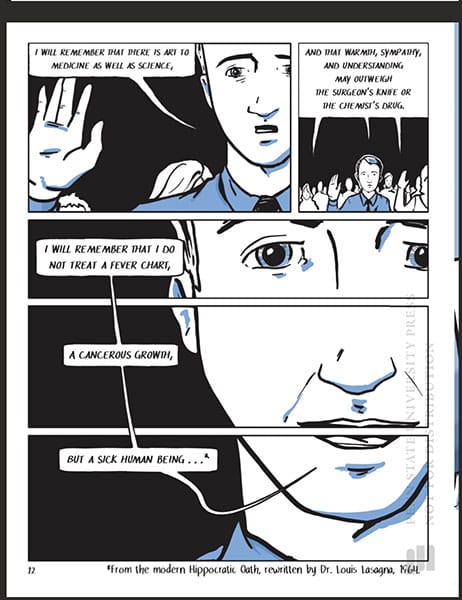
But the pressures aren’t stopping creators who continue forging ahead with new ideas.
“Every talk, panel, and workshop seemed to leave people buzzing with inspiration and new directions to explore,” said Schwartz about the gathering. “The strength of these conferences has always been in the way they pull artists, academics, clinicians, patients, public health professionals, and more together as peers.” Comics, it seems, may be able to put everyone on the same page.
The experts cited in this article had no relevant disclosures.