Admin_Adham
 Jump to Key Points
 Routine childhood and adolescent vaccinations, as outlined in national immunization schedules, have significantly reduced the burden of many dangerous infectious diseases over the past few decades. Some have become so rare that even physicians rarely encounter them in daily practice, whereas others that still cause preventable deaths — particularly among children and adolescents — should no longer exist. These diseases meet the criteria for potential eradication: Transmission occurs exclusively from person to person, there is no significant alternative reservoir for the pathogen, and effective vaccines that provide lasting immunity are available. Measles and poliomyelitis are among these diseases.
Epidemiology distinguishes between the elimination and eradication of these diseases. Although these terms are often used interchangeably, they describe different concepts. A disease is considered eliminated when transmission chains have been interrupted for less than 12 months over a period of 3 consecutive years. Eradication, in contrast, refers to the complete global elimination of a disease so that no new cases occur and vaccination is no longer necessary.
The prospects for measles and polio eradication were once considered particularly promising. Effective vaccines are available for both diseases, and coordinated immunization programs and disease surveillance have led to a substantial decline in infections over the past several decades. In many parts of the world, both diseases have been eliminated or brought close to elimination. Yet, efforts have stalled in both cases for different reasons but with similarly serious consequences.
Measles Failure
Measles is highly infectious and contagious, and bacterial superinfection is a common complication. In approximately 1 in 1000 cases, infection can trigger serious complications such as acute postinfectious encephalitis or, much more rarely, subacute sclerosing panencephalitis, which develops years after the initial infection and is invariably fatal. Research has also shown that measles infection can cause prolonged suppression of the immune system, thereby increasing the susceptibility to subsequent infections.
- Measles eradication stalled; requires ≥95% 2-dose global coverage.
- 2024 measles deaths ~95,000; mostly children <5 years.
- Measles complications: encephalitis, fatal SSPE, prolonged immune suppression.
- Polio setbacks driven by conflict, low coverage, vaccine-derived viruses.
- WPV remains endemic in Pakistan/Afghanistan; resources for eradication declining.
There have been notable successes in the fight against infectious diseases. For example, measles-related deaths worldwide have declined by nearly 90% since 2000. However, measles still caused an estimated 95,000 deaths in 2024, most of which were among children younger than 5 years. In recent years, the age distribution of infections has also shifted, with more cases occurring among infants, older children, and adolescents than among toddlers. This shift may be partly related to missed vaccinations during the COVID pandemic and delays in receiving vaccinations that were missed.
In 2024, measles cases increased substantially, including in highly developed countries such as the US, the UK, and Germany. Several countries have since lost their previously achieved status of measles elimination.
Is measles eradication realistic? The World Health Organization’s (WHO’s) current strategic framework for measles and rubella sets out an elimination strategy for 2021 through 2030. Published in 2020, the framework had already anticipated some effects of the pandemic, including the temporary decline in measles transmission resulting from pandemic-related restrictions on social contact.
Following the sharp increase in measles cases in 2024, the overall number of cases declined slightly. However, vaccination coverage remains insufficient to eliminate this disease worldwide. Failure to eradicate measles is largely political. No other vaccine has generated as much controversy as the measles vaccine, and public and media discussions about childhood infectious diseases continue to be influenced by misinformation, irrational claims, and rejection of established scientific evidence.
Social media misinformation, vaccine hesitancy, and organized opposition to vaccination have reinforced each other. However, these developments have not emerged in isolation. At the beginning of the COVID pandemic, it was already becoming clear that vaccine hesitancy and organized opposition to vaccination could gain momentum. Newly developed COVID vaccines have been used to question vaccine effectiveness and safety more broadly. For measles vaccination, this involved reviving long-discredited myths. Social media and statements by some political actors have increased uncertainty about measles, mumps, and rubella (MMR) vaccination among parents, contributing to declining vaccination rates.
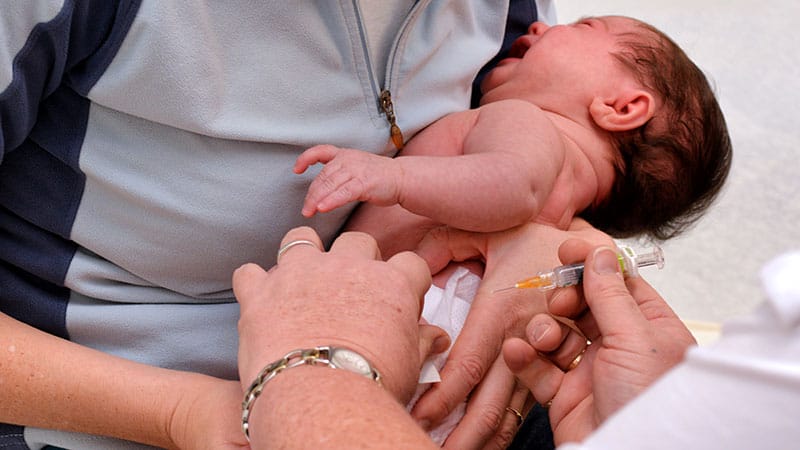
Vaccination remains the key to measles eradication. On average, an infected person transmits the virus to 18 others. To eradicate the disease, the transmission chains must be interrupted as quickly as possible. This requires global coverage of at least 95% with two doses of measles-containing vaccines. In practice, this target has not yet been reached worldwide. Currently, 84% of children receive the first dose, and 76% receive the second dose.
Failure to increase vaccination coverage also affects the elimination of rubella and efforts to reduce mumps infections because MMR combination vaccines are now generally used.
To improve vaccination coverage, many countries have introduced requirements for proof of immunization for people visiting or working in healthcare and long-term care facilities, daycare centers, preschools, and other high-risk settings. Early successes are emerging: Countries that have introduced mandatory measles vaccination have seen at least modest increases in vaccination rates. However, closing the existing gaps and reaching the 95% target will require additional education and counseling programs. Without these measures, measles is likely to remain endemic in many countries for some time.
Polio Conflict
Although poliomyelitis was considered close to eradication several years ago, progress has been stalled. However, unlike measles, these setbacks have had little to do with the anti-vaccination movement. New outbreaks can occur when vaccination coverage is insufficient; however, in many cases, the problem is not vaccine acceptance. Instead, vaccination campaigns are often difficult to organize in war-torn and crisis-affected areas, where poor sanitary conditions also facilitate the spread of the virus.
This was recently evident in Gaza, where interruptions in routine childhood vaccinations led to the first major outbreak in the region in 25 years.
Polioviruses continue to circulate and cause infections largely because of vaccine-derived viruses. Wild-type poliovirus (WPV) remains endemic only in Pakistan and Afghanistan, although the number of infections has declined sharply in both countries over the past several decades. The oral live polio vaccine (OPV) originally contained all three poliovirus serotypes (WPV1, WPV2, and WPV3). To further reduce the already low risk for vaccine-associated paralytic poliomyelitis, WPV2, which is no longer circulating in the wild, was removed from the trivalent vaccine. However, live vaccines can occasionally give rise to vaccine-derived viruses through genetic changes, which can then cause outbreaks in populations with insufficient immunity.
Several strategies can be used to address this problem. As a general rule, immunization should be carried out with an inactivated PV. However, during outbreaks, the oral live vaccine remains useful because attenuated vaccine viruses can be shed by vaccinated individuals and help provide immunity to others who are not reached by vaccination campaigns. A novel type 2 OPV has been developed for this purpose. It is genetically more stable than its predecessor, monovalent OPV type 2, and is therefore less likely to undergo mutations that allow the virus to regain virulence. Vaccines against the much rarer vaccine-derived serotypes 1 and 3 are also expected to become available soon.
Isolated cases of vaccine-derived poliomyelitis can also occur outside crisis regions, including in highly developed countries. Most of these cases are associated with travel. During outbreaks, rapid containment vaccination with an oral vaccine, combined with the highest possible vaccination coverage among young children, can help make significant progress toward interrupting transmission. In the long term, children from all countries should be immunized exclusively with an inactivated PV.
Despite the challenges of reaching children in some remote areas of Afghanistan and Pakistan, local immunization teams remain optimistic that the last circulating WPV can be eradicated. Whether this will happen in the near future depends largely on the available resources, which have, unfortunately, been substantially reduced in recent years.
To date, the complete eradication of a highly infectious and dangerous disease has only been achieved with smallpox, along with rinderpest, which does not affect humans. The eradication of smallpox was a milestone in the history of infectious disease control and was made possible by a consistent vaccination strategy sustained over decades.
When British physician Edward Jenner vaccinated the first child against smallpox in 1796, he could not know where the experiment would lead, but he understood the importance of vaccination. Before smallpox vaccination was introduced, 1 in 5 infected children died from the disease. Few medical innovations have saved as many lives as vaccinations against infectious diseases. However, it took nearly 200 years for smallpox to be eradicated. In 1980, the WHO published the “Declaration of global eradication of smallpox.”
Modern health tools are needed to eliminate or even eradicate additional infectious diseases, including safe and effective vaccines, medical expertise, logistics, and methods and technologies for monitoring infections and pathogens. In recent decades, significant progress has been made against several dangerous pathogens through the development of new vaccines and medications that could enable regional elimination. Examples include malaria and tuberculosis, as well as human papillomavirus-associated cervical cancer, which can be prevented in nearly 100% of cases through vaccination.
For diseases that can be eradicated, failure to achieve elimination is primarily a political issue. Once an infectious disease is brought under control to a point where it is no longer seen as a major public health threat, efforts to combat it often lose priority. Funding declines, as does cooperation with international health organizations. However, the examples of polio and measles show that the final stage is critical. Even a difference of only a few percentage points from the target vaccination rate can be sufficient to prevent eradication goals from being achieved.
Barbara Zenz is a physician and medical journalist based in Paris. She specializes in infectious diseases, epidemiology, vaccine development, and public health and covers scientific and medical advances.
This story was translated from Univadis Germany, part of the Medscape Professional Network.