Admin_Adham
It’s rare that terms such as “life changing,” “tremendous advance,” or “a difference of night and day” describe an evolving class of therapeutics without sounding like hyperbole. But in the case of biologics in dermatology, these assessments might be spot on.
In fact, these agents continue to revolutionize patient care, experts say.

Dermatologists in practice for two decades or more have borne witness to this transformation driven by biologics and their biosimilars. Many dermatologists have gone from offering patients earlier, limited options, often less effective and more challenging to administer, to agents that have had a “tremendous positive impact” on patient quality of life, said Ahuva Cices, MD, assistant professor of dermatology, at the Icahn School of Medicine at Mount Sinai in New York City.
It’s not an entirely rosy picture, however. Some challenges with biologics remain, primarily limited access for some because of cost and insurance coverage.
The Pre-Biologics Era
The 1990s and early 2000s were characterized by a deeper understanding of the various components of the immune system dysregulated by autoimmune diseases such as psoriasis and atopic dermatitis. But it was really the need for more effective psoriasis treatments that drove the early years of biologics development, experts point out.

“I trained and practiced for a year or two without biologics,” said Lawrence Green, MD, clinical professor of dermatology at George Washington University School of Medicine and Health Sciences in Washington, DC. ”Before biologics, people who suffered from severe psoriasis were the most difficult patients to treat.” Protocols were complicated, required frequent office visits and lab monitoring, and often left patients unhappy.
“As a dermatologist who also has psoriasis, I so sympathized with their suffering,” Green added.
Before biologics, people with severe psoriasis sometimes were treated with topical tar and ultraviolet (UV) B light therapy (and UV light therapy continues to be a component of psoriasis treatment). Another common treatment was methotrexate, which required regular laboratory monitoring for organ toxicity, particularly during extended use.

“I frequently tell our residents that back in day, it was hard to treat difficult cases of psoriasis,” said Steve Daveluy, MD, professor of dermatology and dermatology residency program director at Wayne State University in Detroit. “Those older medications carried much higher risks or side effects, which we always needed to balance with the benefits.
“There were some really challenging cases that pushed our limits. Now we’re spoiled with highly effective, super-safe biologics,” added Daveluy, who is also associate editor of JAAD Case Reports and co-editor in chief of the Journal of Integrative Dermatology.
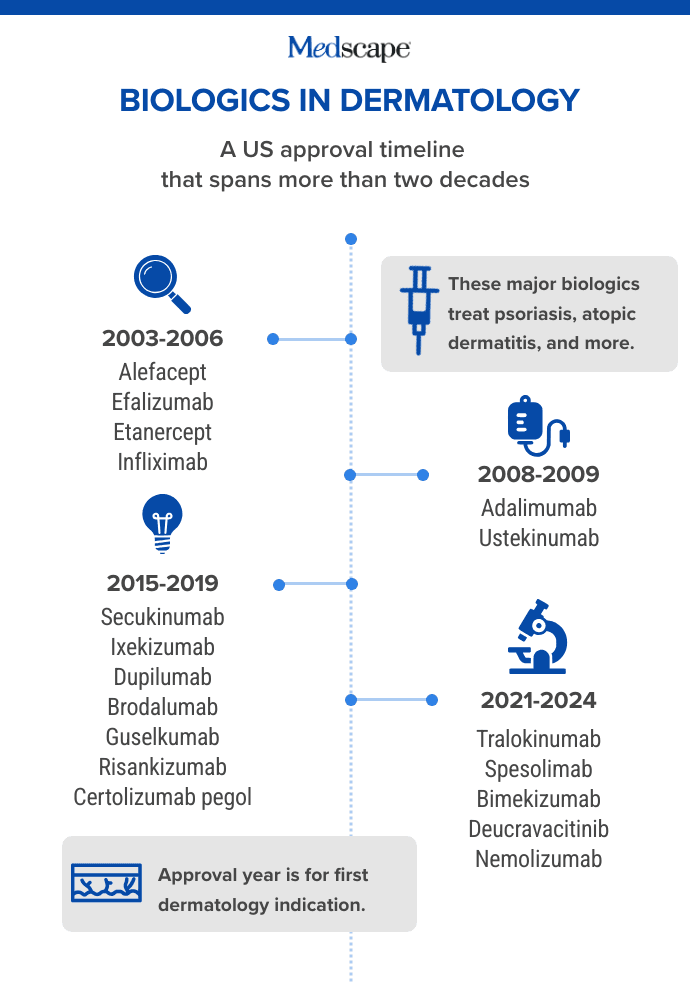

Dupilumab (Dupixent), a monoclonal antibody that inhibits interleukin (IL)-4 and IL-13 signaling, was approved in 2017 for adults with moderate to severe atopic dermatitis. This agent has made a positive difference for the patients Sandra Marchese Johnson, MD, treats. “Before approval of Dupixent for atopic dermatitis, we used to admit people to the hospital for infection control, and ‘ soak and smear’ to clear their skin,” for severe cases, added Johnson, a private practice dermatologist in Fort Smith, Arkansas, and. “We also used a lot of UV light and methotrexate and way too much systemic steroid therapy.”
And before biologics became available, dermatologists used medicines with higher toxicities and lower efficacy: oral vitamin A medicines for psoriasis, as well as UV light, methotrexate, and cyclosporine, for psoriasis and atopic dermatitis.
Biologics have also permitted more of a holistic approach to patient care that was not possible previously, Cices told Medscape.
“For example, with psoriasis we have established the association of systemic inflammation including inflammation in the joints that results in irreversible joint damage, vascular inflammation that is associated with cardiovascular disease, and associations with metabolic syndrome and related sequelae,” she said.
Biologics allow for rapid skin clearance in many patients while also improving overall health, which, Cices said, “represented a true paradigm shift, moving us from merely suppressing symptoms to altering the course of disease and preventing long-term harm.”
Biologics Are Evolving Too
The biologic classes of dermatology treatments have evolved since their introduction decades ago as well. Green said, “We have narrowed and fine-tuned mechanisms of action in terms of targeting the exact immune dysfunction in psoriasis, so we can minimize risk of harming needed immune functions and, of course, maximize safety.”
Daveluy added, “Now, we have highly effective biologics with better safety profiles, which makes the risk/benefit profile much better. It’s a wonderful new era of managing both plaque psoriasis and generalized pustular psoriasis with biologics that reliably shut down the disease safely and effectively.”
It is now possible to rapidly control disease in patients with psoriasis, and a goal of treatment is now 1% or less skin involvement, Daveluy said. “This level of treatment success has changed the primary challenge, he added. “The biggest hurdle for a patient is no longer finding a medication that will work for them. Instead, it’s making sure that your dermatologist is up-to-date with the latest treatment options.”
Boosting Quality of Life for Many
Beyond safety and efficacy, biologics have been associated with a “huge improvement” in quality of life, said Johnson, who is also with the department of dermatology, UAMS College of Medicine in Little Rock. For example, studies have shown growth acceleration in children and less school or work absenteeism among people with atopic dermatitis treated with dupilumab.
Quality of life with biologics is “a difference of night and day compared to before 2000,” Green agreed. “The patients who were the most difficult to treat before the turn of the century are now among the easiest and happiest ones we have.”
“When coupled with their robust safety, biologics have truly advanced the practice of dermatology more than any class of medications we’ve seen,” Daveluy said.
The profound human impact of biologics goes beyond physical improvements such as reducing pain, itch, and disability, Cices said. Removing the stigma associated with skin disease leads to improvements in self-esteem, mental health, and sleep that allow patients to live a normal life. “For many, now the only disease [stigma] may be taking their medication, with no signs of active disease or only scars from prior disease activity. Patients describe being able to wear clothing they were afraid to wear previously due to exposing skin that would prompt embarrassing and difficult conversations, improved social interactions, improved sleep, and improved work or school functioning.”
“The emotional and psychological relief is often as significant as the physical improvement,” Cices added.
Expanding Indications
Even though biologics had their greatest dermatologic impact early on for people with psoriasis or atopic dermatitis, their indications are expanding.
Treatment of hidradenitis suppurativa (HS), for example, “has been revolutionized by the introduction of biologics,” Daveluy said. HS is in the early phase of this new treatment era, with three approved biologics. ”This has had a profound impact for HS patients. We had very limited options prior to the biologics.”
“We’re now able to shift treatment away from antibiotics, which is beneficial for HS patients,” and helps improve antibiotic stewardship. Ideally, initiation of biologic therapy starts early in HS, before the irreversible development of skin tunnels, Daveluy said.
Biologics are being explored for less common inflammatory skin diseases such as pyoderma gangrenosum, alopecia areata, cutaneous lupus, prurigo nodularis, chronic hives, bullous pemphigoid, and other chronic pruritic skin conditions. Biologics may also someday treat vitiligo, experts predict. Dupilumab was approved for treating bullous pemphigoid in 2025.
“Many rare diseases have benefited from biologics, though it is far more difficult to get FDA-approved therapies for these conditions,” Cices said. A success story is the approval of spesolimab in 2022 for generalized pustular psoriasis, she added, which is distinct from plaque psoriasis in terms of pathophysiology, presentation, and treatment.
“For many patients with these conditions, biologics represent the first time they have had meaningful relief, reduced suffering, and restoration of dignity as well as daily functioning,” she added.
Caveats and Remaining Challenges
Cost, insurance authorization, and access continue to be a challenge in the biologics era. “Unfortunately,” Green said, biologics “are very difficult to get for our patients. Insurance companies put up roadblocks all the time, and many patients continue to suffer needlessly.” He described the necessities of “constantly battling and spending hours filling out insurance company paperwork over and over so our patients can get their medications.”
Insurance coverage and prior authorization are “now a regular part of practicing dermatology, and biologics often require some navigation to gain access for patients,” Daveluy said. “That should not dissuade dermatologists from providing these incredible treatment options to their patients.
“As with any medication, it’s important to take an individualized approach when selecting a biologic for your patient, considering comorbidities, other medical problems, potential side effects, lifestyle factors, and accessibility to engage in shared decision-making and discover the optimal treatment for each patient,” Daveluy said. There are many resources to help staff handle the task of prior authorization with ease, he added, including template letters from the American Academy of Dermatology and the HS Foundation.
A Promising Future?
New areas of interest for biologics include treating diseases with scarring and fibrosis such as scleroderma, scarring alopecia, and keloids, Cices said. “The future will likely incorporate precision medicine, using patient-specific biomarkers to identify disease subtypes and match patients with more effective and tailored treatments.”
The formulations for biologics will evolve as well, Green predicted. “I think we will be seeing oral or pill medications that work like biologics coming in the next 5 years. Another possibility in the future is longer-lasting biologic injections so that a patient may be able to get their atopic dermatitis or psoriasis clear by just taking one or maybe two injections a year,” he added.
“I’m thrilled by the trend we’ve seen in psoriasis, where biologics have made management of even the most severe cases beyond simple, and the fact that we’re seeing similar progress in atopic dermatitis, hidradenitis suppurativa, and other complex skin diseases,” Daveluy said.
“It’s exciting to see our treatment goals shift to higher levels of disease control as highly effective therapeutics emerge,” he added. He credits the “brilliant and innovative leaders in research advancing our specialty at an incredible pace.”
Johnson’s practice is a clinical site for numerous trials of treatments for dermatologic conditions for which patients have been suffering greatly with no satisfactory treatment. “We will definitely have new agents, treatments for difficult-to-treat conditions, more targeted treatments, safer treatments, more competitors, and hopefully less expensive, even more efficacious treatments that are easy to obtain for our patients.”
This is the first installment of a four-part series on biologics and dermatology, further exploring the impact of biologics in the treatment of dermatologic diseases. Future installments will focus on psoriasis, atopic dermatitis, and other skin conditions.
Green is an investigator, advisor, and/or speaker for Alumis, Amgen, Arcutis Biotherapeutics, Bristol Myers Squibb, Dermavant Sciences, Galderma, Highlightll, Incyte, Janssen, Lilly, Pfizer, Takeda Pharmaceuticals, and UCB. Daveluy disclosed he is a speaker, consultant, and researcher for AbbVie, Novartis, and UCB and a speaker for Boehringer Ingelheim. Cices and Johnson reported no relevant financial disclosures.
Damian McNamara is a freelance contributor to Medscape Medical News. He worked full-time for Medscape and WebMD from 2018 to 2024. Damian has a BA in chemistry and an MA in science, health and environmental reporting/journalism. He works out of a home office in Miami, with a 100-pound chocolate lab known to snore under his desk during work hours.