Admin_Adham
In the second part of our conversation with Eugene Braunwald’s biographer, Thomas Lee, MD, we ask him how Braunwald became the father of modern cardiology and how he handled the discovery that one of his favorite protégés had fabricated research.
To read the first part of our interview, see “Braunwald’s Uncertain Beginnings and Concerns for the US.”
Braunwald is called the father of cardiology. In the book, you tried to quantify that. Were those graphics commissioned for the book?
Yes. I met people who worked for McKinsey through my management role at Mass General Brigham. When I described Braunwald and the biography, Leigh Weiss, who was a social network scientist, told me that there were tools for analyzing someone’s impact. The traditional way would have been number of articles, citations, trainees, and h-index.
Instead, we quantified him as a connector (Figure 1). For example, if I’m a co-author with Braunwald and there are a bunch of other co-authors who I’ve never worked with directly, Braunwald is the connection.
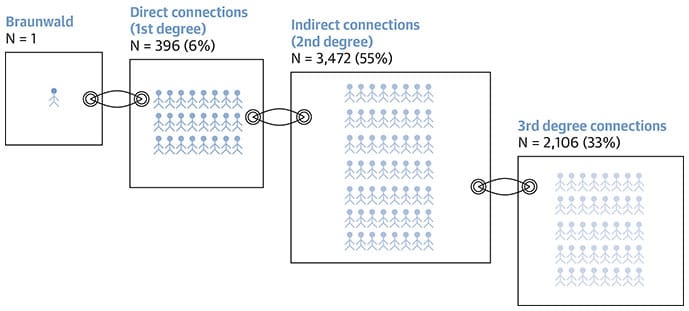
He had such broad interests: health policy, cost-effectiveness, and basic science. He was the connector because he was interested in looking at the problem from every angle and would collaborate with laboratory scientists, public health people, and clinical trialists.
When you plot his betweenness points graphically (Figure 2), Braunwald is pulled to the center of the universe.
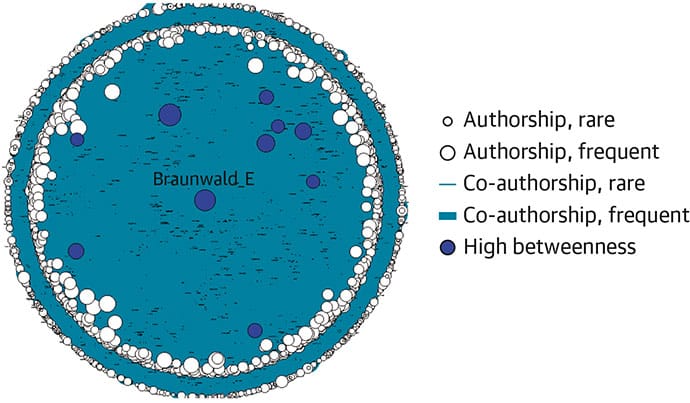
We searched PubMed for cardiovascular papers. Then we looked for people with at least four cardiovascular papers in top journals (the criteria are in the book appendix).
We came up with a universe of about 6000 authors over a 50-year time period and looked at the most productive people to see who had the most connections. We bought data from PubMed; it was expensive: $20,000. I paid for this out of my research money. It was painful. Today I’m sure you can do it much more inexpensively.
Weiss had done these analyses in other fields and had never seen anything like Braunwald. He was not only pulled to the center on topic after topic but also there decade after decade over 50 years.
There are people who made a big splash in cardiology over 10-20 years, but to be in the top 10 over 50 years is beyond belief.
How did he change cardiology?
He took medicine and cardiology from being passive to active.
When he started his training, there were no ICUs, no coronary care units, no defibrillation, and no cardiopulmonary resuscitation (CPR). There were no beepers because there was no rush to get cardiologists anywhere because there was nothing they could do when they got there.
No one believed that you should touch the heart.
When Braunwald came along, things were poised to get active, tools to do cardiac catheterization were coming, and people were working on CPR and defibrillation.
It wasn’t only him, of course.
Braunwald showed that a myocardial infarction didn’t happen in an instant, that it played out over hours, and that meant we could intervene with treatments like thrombolytic therapy. We could reduce infarct size by using beta – blockers and ACE inhibitors. The fact that we could change the natural history, that was not a part of medicine when he entered.
Do you think he was a genius or just incredibly hardworking?
I don’t think he would call himself a genius; he always felt that he was in the right place at the right time. But he was very open and he was always thinking.
At grand rounds, when I was in training, we used to say of the big shots that most were thinking of something to say, but Braunwald was just thinking. He would ask the most interesting questions.
His family would attribute it to what he went through as a child, escaping from the Nazis in Austria, going to England, being part of Operation Pied Piper, going to Brooklyn. He had to be creative, he had to work really hard, because life was so uncertain for him. His daughters feel that that is an essential part of his story.
Did he have survivor’s guilt, where he felt pressure to make something of his life, because of all the European Jews who didn’t survive?
It wasn’t so much guilt but more of an awareness that if we don’t work our tail off, bad things could happen.
A lot of Americans who have been here for multiple generations feel like nothing bad could ever happen to them. I’m a son of immigrants myself, and immigrants know bad stuff can happen. Braunwald was very much of the belief that you have to work really hard to survive.
He often took on additional work, such as emergency room shifts during fellowship and advanced mathematics classes.
He worked hard, but it wasn’t just to pad his CV with skills. He focused on things that interested him. He gave a lot of time to music because he really loved it. He picked the music for his memorial service. He had a rich life.
He worked more than 90 hours a week for most of his life. What did he think of today’s focus on work-life balance? He was initially skeptical of shift work and hospitalists, right?
If he was awake, he was working. What was impressive was that he adapted with the times. He understood that things were changing. His protégé, Lee Goldman, introduced the term hospitalist and created that program. Braunwald’s initial skepticism was changed when he saw that it made some things better. He was tough-minded, but he was open-minded.
Mentorship and teaching seemed quite important to him.
His textbooks and spreading knowledge in general were very important to him. He was an important player in the cardiology journal world, and the effect of Harrison’s Principles of Internal Medicine under his leadership was important to him.
He was proud of the fact that the Brigham trained not only a lot of important cardiologists but also important people in other fields. He created the MD-PhD program. People like Jeffrey M. Drazen and Edward J. Benz who did very important pulmonary and cancer research, respectively.
He nurtured a generation or two who had a great impact and not just in medicine. Jim Kim became head of the World Bank, and Paul Farmer had an impact that went beyond traditional academic medicine.
Sadly, we’re familiar with research fraud these days, but was the Darsee affair, where one of Braunwald’s students fabricated data, one of the first such scandals?
It wasn’t the first research fraud scandal by any means, but it was certainly a significant one that got even more attention because it was in Braunwald’s laboratory.
With Braunwald being so successful on so many fronts, as a researcher, running a department of medicine, editing textbooks, there were jealous people who did not want to believe it was humanly possible to do a good job in everything.
In truth, he was stretched, and the nature of research was changing. The old model of an intimate research shop, where everything was visible, was giving way to big science because the questions required more people, equipment, and money to answer.
The people who were not rooting for Braunwald pounced when Darsee committed his fraud. What may be difficult for people to understand in retrospect is what a golden boy Darsee was. Everyone loved this guy. I didn’t directly interact with him, but he was charming and a great doctor. The nurses loved him. It was an unbelievable shock.
Braunwald gave Darsee a second chance and took his word that the fraud at the Brigham was a one-off, but he regretted that later, right?
That is one of the decisions that he regretted. Today you would protect yourself and not give someone a second chance. I don’t know that the world is better because of that. That’s partly why I wrote the book because it wasn’t the only setback he had in his career, but it’s probably the most famous one.
We talked about it and I wrote directly about it, and he was fine with that.
Braunwald could be ruthless if he didn’t feel people were pulling their weight.
He would say, “Your talents will not be appreciated here.” It was blunt feedback, but it was done with some affection and respect. He was honest with people.
Now for people who betrayed him, as I mentioned in the book, he would say, “Lose my phone number,” and he wouldn’t go back.
Was Braunwald competitive with other researchers?
I would say he was very proud of the work that he helped lead, and he was very proud of his trainees. I never heard him talk about anyone as a competitor. That could be the height of arrogance, but I’m ready to buy that he wanted to advance medicine and science because when other people did things, he seemed thrilled.
He developed very close relationships with two other great figures who led departments of medicine at that time: Donald W. Seldin and Holly Smith out at UCSF. They really defined what a great academic medical center was. They figured it out together, and it never felt like they were competing. At the same time, the Brigham was an academically outstanding place, and it did the best in the country in the match beginning in the late 1970s.
He was proud of that, but it didn’t feel like he was playing a game or that this was critical.
Do you think we’ll see a career like that again?
I don’t think so. Not in academic medicine. But there’s an opportunity for people to learn from what he did and adapt it to their own life. This is why he gave me permission to write that book.