Admin_Adham
Izokibep Enthesitis Benefit Lacking in Phase 2b/3 PsA Trial
VIENNA — The investigational interleukin (IL)-17 inhibitor izokibep hit its mark when it came to improving overall disease activity in people with active psoriatic arthritis (PsA) in a phase 2b/3 trial, but it was no better than placebo at reducing inflammation of the entheses.
This apparent and unexpected lack of effect in the entheses was a key talking point after Philip J. Mease, MD, presented the late-breaking trial findings at the European Alliance of Associations for Rheumatology 2024 Annual Meeting.
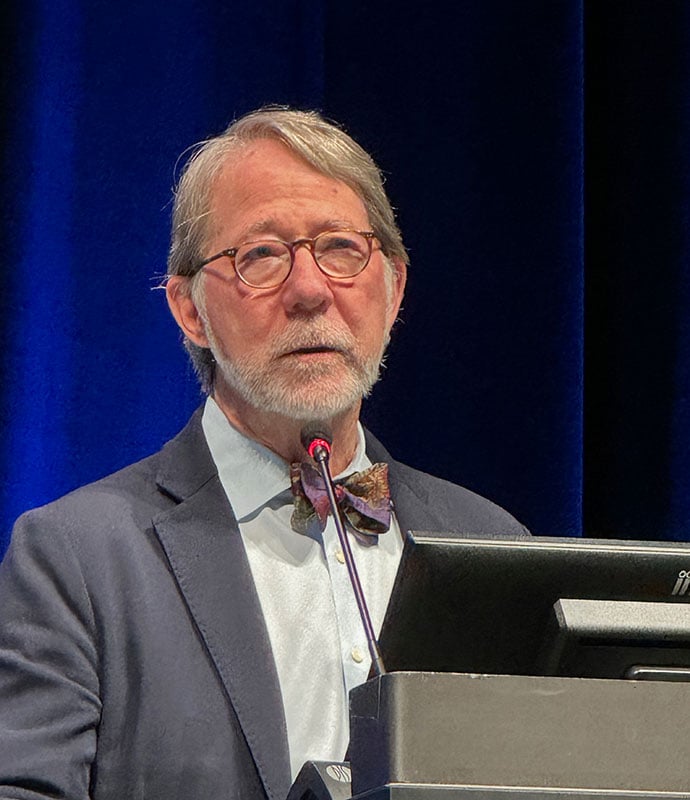
At just 18.6 kilodaltons in size, izokibep is just "one tenth the size of a standard monoclonal antibody" and is classed as a small protein therapeutic, Mease said. It has a "very tight" binding affinity for IL-17A, and because it also binds to albumin, it has a prolonged half-life compared with other IL-17 inhibitors. Potentially, it should be able to "penetrate into difficult areas," such as the entheses, he said.
Prespecified Enthesitis Analysis
However, results of a prespecified secondary analysis conducted in 209 of the 343 trial participants who had received treatment showed no significant difference in the proportions with enthesis resolution at 16 weeks, defined as a Leeds Enthesitis Index (LEI) of 0.
Comparing two dosing regimens of izokibep 160 mg once weekly (QW) vs every other week (Q2W) with placebo, enthesitis resolution was seen in 45%, 56%, and 47%, respectively, of patients.
The LEI is "sometimes subject to problems with evaluation because of placebo response, which is what we see here," noted Mease, who is director of Rheumatology Research at the Providence Swedish Medical Center and a rheumatology professor at the University of Washington School of Medicine in Seattle.
An exploratory analysis showed that there was a better response for izokibep vs placebo if the analysis included only patients with higher LEI scores at baseline, at 8.0% (n = 12) for placebo, 22.0% (n = 9) for izokibep 160 mg QW, and 50.0% (n = 12) for izokibep 160 mg Q2W.
Main Efficacy Data
The primary endpoint for the trial was the proportion of patients who had 50% improvement in American College of Rheumatology response criteria (ACR50) at 16 weeks. This showed a clear advantage for treatment with izokibep 160 QW and Q2W compared with placebo, with a respective 40%, 43%, and 15% of patients meeting this endpoint.
Corresponding ACR20 response rates were 59%, 64%, and 35%, respectively; ACR70 response rates were a respective 25%, 23%, and 5%.
In addition to ACR70, izokibep 160 QW and Q2W met a number of other "high hurdle" efficacy endpoints better than did placebo, Mease reported. A 90% reduction from baseline in the Psoriasis Area and Severity Index (PASI90) was achieved by a respective 64%, 58%, and 12% of patients, and a 100% reduction in this index (PASI100) was achieved by a respective 51%, 47%, and 12%. And 41%, 42%, and 14% of patients, respectively, met the criteria for minimal disease activity.
Patient Population
Mease pointed out during his presentation that the trial included patients with adult-onset PsA that had been ongoing for ≥ 6 months. Patients had to have at least three tender or swollen joints and an inadequate response, intolerance, or contraindication to commonly used front-line therapies such as nonsteroidal anti-inflammatory drugs, conventional synthetic disease-modifying antirheumatic drugs (csDMARDs), and tumor necrosis factor inhibitors (TNFi).
In fact, around half of the participants across the three treatment arms had received prior csDMARDs, and almost a quarter had received a TNFi.
The mean duration of disease was around 7 years, the average age was about 50 years, and the majority of the participants were White individuals. There were more women than men in the placebo vs the izokibep arms (43.4% vs about 60.0%).
Adverse Events
Injection site reactions were the most common adverse events, most of which were mild to moderate. Very few (< 1% to 4%) led to any need to discontinue the drug.
Serious adverse events occurred at low rates in all study arms: 0.8% for placebo, 2.7% for izokibep QW, and 1.8% for izokibep Q2W.
One patient each (0.9%) in the izokibep arms developed ulcerative colitis, whereas none in the placebo group did. Only two patients developed candidiasis. One was in the placebo group and had a skin infection, and the other was an oral infection in the QW izokibep arm.
There were no cases of uveitis, suicidal ideation, or deaths reported.
Comments on the Study

During the discussion that followed the presentation, Walter P. Maksymowych, MBChB, of the University of Alberta in Edmonton, Alberta, Canada, addressed the dosing regimens used.
"Looking at the side effect profile and then looking at the response rate, comparing the weekly dosing and every 2 weeks, do you think, in hindsight, you might be remiss that there wasn't an additional dosing on a monthly basis, especially since this is a construct that is meant to prolong the half-life of the molecule?" he asked, adding that perhaps this should be something to consider in future studies.
Mease responded that there had been a fourth dosing arm in the trial — izokibep 80 mg once a month — but because there were only eight patients, the data were not sufficiently robust to analyze.

Commenting on the study for Medscape Medical News, Laura Coates, MBChB, PhD, said: "It's a pretty standard phase 2b/3 study," and the outcomes were not wildly different from what has been seen with other IL-17A inhibitors.
"In phase 2, the enthesitis data looked really good; in phase 3, the enthesitis data looks the same as for any other IL-17 inhibitor," Coates said.
More and longer-term data are needed to see if "the theoretical biological difference in the drug design translates to a different clinical outcome or whether it's another IL-17," added Coates, a clinician scientist and senior clinical research fellow at the University of Oxford in Oxford, England.

Dennis McGonagle, MB MCH BAO, PhD, of the University of Leeds, England, also picked up on the enthesitis data, echoing the conclusion that the phase 2 enthesitis data were "spectacular" and noting that "it's a real inversion of what was expected, given the small molecule."
The study was funded by Acelyrin.
Mease reported receiving grants or other research funding from AbbVie, Acelyrin, Amgen, Bristol Myers Squibb, Eli Lilly, Janssen, Novartis, Pfizer, and UCB; consulting fees from AbbVie, Acelyrin, Alumis, Amgen, Bristol Myers Squibb, Cullinan, Eli Lilly, Inmagene, Janssen, MoonLake, Novartis, Pfizer, Takeda, UCB, and Ventyx; and honoraria from AbbVie, Amgen, Eli Lilly, Janssen, Novartis, and Pfizer for the Group for Research and Assessment of Psoriasis and Psoriatic Arthritis, Outcome Measures in Rheumatology, and Spondyloarthritis Research and Treatment Network.
Maksymowych has received research funding, grant support, and honoraria for serving as a consultant to multiple pharmaceutical companies, including AbbVie, Boehringer Ingelheim, Celgene, Eli Lilly, Galapagos, Janssen, Novartis, Pfizer, and UCB. He is chief medical officer of CARE Arthritis Limited.
Coates has received speaking fees from AbbVie, Amgen, Biogen, Celgene, Eli Lilly,
Galapagos, Gilead, GlaxoSmithKline, Janssen, Medac, Novartis, Pfizer, and UCB; has served as a consultant for AbbVie, Amgen, Bristol Myers Squibb, Boehringer Ingelheim, Celgene, Domain, Eli Lilly, Galapagos, Gilead, Janssen, Moonlake, Novartis, Pfizer, and UCB; and has received grant/research support from AbbVie, Amgen, Celgene, Eli Lilly, Gilead, Janssen, Novartis, Pfizer, and UCB.
McGonagle has received consulting fees, speaker honoraria, research/grant support, and/or travel support from AbbVie, Almirall, Bristol Myers Squibb, Eli Lilly, Janssen, Novartis, Pfizer, and UCB.
Sara Freeman is a medical journalist and writer based in London, United Kingdom. She is a regular contributor to Medscape Medical News, Medscape News UK, and other specialist healthcare media outlets.