Admin_Adham
 Jump to Key Points
 Not many people are enthusiastic when asked to blow into a breathalyzer. But maybe doing so with no blue and red swirling lights and a law enforcement officer supervising — and measuring something they might want to know — will make a difference.
Considering the current global epidemic of metabolic diseases, there are no simple and fast ways for patients to know whether lifestyle changes are affecting their metabolism. One way to do this is by measuring ketones or acetone, which determine whether the body is in ketosis, a metabolic state where the body breaks down fat to create energy. However, current methods for measuring ketosis either require patients to come in for testing or lack the sensitivity needed to detect smaller changes.
“It’s crazy that metabolism is ultra-important for everyone’s life and there’s not really a method to measure it,” said Jan van den Broek, co-founder of Switzerland-based health tech company Alivion AG. “Everyone has a smartwatch giving you your pulse 24/7. But if you ask, okay, and what is your metabolism doing, people usually don’t know.”
Aiming to create a device patients could use routinely in their own homes, van den Broek teamed up with researchers at ETH Zurich and the University Hospital Zurich to develop a handheld device that measures acetone when patients exhale into it. A study with their findings was published in Device (a Cell Press journal) this past July.
- Handheld breath acetone analyzer detects ketosis noninvasively; app-guided sampling improves consistency.
- Output matched mass spectrometry in 12 healthy adults; also tracked blood ketones/glucose changes.
- Device detected metabolic shifts during ketogenic diet, intermittent fasting, and exercise interventions.
- Home use may enable frequent longitudinal monitoring; current use mainly clinical research.
- Larger studies needed; clinical utility may be limited to select metabolic/weight-management populations.
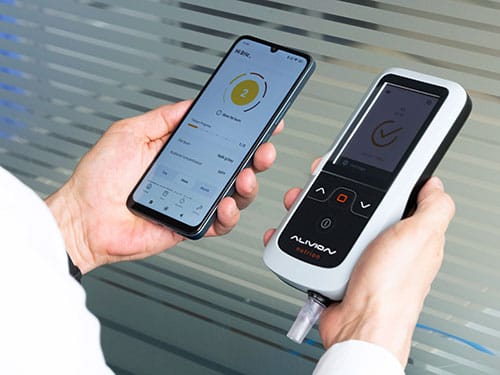
Because the breathalyzer is noninvasive, “you can just repeat it as often as needed,” said study co-author Simone Hersberger, a PhD candidate at ETH Zurich. The device also connects to a smartphone app, which guides users on how to collect samples.
How They Got Here
To test the device, the researchers had 12 healthy adult participants collect samples, finding that its output matched results from mass spectrometry, the gold standard method for measuring acetone in the lab.
After this, participants underwent diet or exercise interventions to see how the device’s output changed in response to real-world changes in metabolism. “The system might work in the lab,” explained van den Broek, “but [it] might not work in the real world.”
In the dietary intervention, three participants followed three different diets over 3 weeks. First, they followed their usual diets, followed by 1 week on a ketogenic diet, where daily carbohydrates were limited to 25 g, and finally a week of intermittent fasting, where participants ate all their meals during an 8-hour window each day.
In the exercise intervention, meanwhile, five participants were asked to run at either high or low intensity. To personalize this, the researchers measured participants’ heart rates, using this to determine what defined high and low intensity for each individual. After this, participants were given different meals, including a ketogenic, or low-carb, meal; a carbohydrate-rich meal; or no meal.
Throughout these interventions, participants measured their acetone with the handheld device. One of the biggest challenges in this, Hersberger said, was making sure that the way different participants collected their samples stayed consistent so results could be compared.
For example, the pressure of the exhale needs to stay within a certain range. To help with this, the app the device connects to has built-in mechanisms to correct users on their breath. “While you exhale, you can see this balloon, or this circle, grow,” explained Hersberger. Using this visual, participants could see if the force of their breath was in the right range and restart if needed.
Overall, Hersberger was impressed at participants’ deftness with the device. “They were learning very quickly how the device works, how to use it,” she said.
The team also measured participants’ acetone levels using mass spectrometry and measured other metabolic markers, including blood ketones and glucose. Measures taken by the handheld device matched these other measures, indicating that it has a similar ability to detect metabolic changes.
Consumer vs Clinical Use
One of the limitations of this device is real-world use. It could easily be marketed to consumers looking for more weight-loss and health tools (the health “optimization” crowd on social media comes to mind), but Reshmi Srinath, MD, would like to see expanded findings from larger participant pools before acknowledging clinical use. Srinath, an endocrinologist who directs Mount Sinai’s Weight and Metabolism Management Program in New York City also worries that measuring ketosis won’t fit the goals of all patients. “From a weight management perspective, I’m not generally having patients measure ketones or wanting them to be in ketosis,” she said. “My concern is the patient population for this kind of device is going to be very limited.”
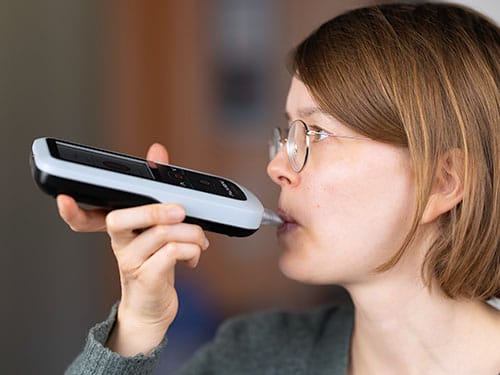
In July, Alivion AG released the device under the name Nutrion, though for now it’s primarily used in clinical research, where it lets patients take breath samples at home throughout the day, collecting far more data than what’s usually possible. “This was just unheard of in the past, to generate this output,” says van den Broek, adding that this research could greatly improve understanding of how factors like diet and exercise influence metabolism in the short term.
While Nutrion currently doesn’t offer any advice about what to do with the data it collects, it could eventually be used to personalize metabolic treatment plans, allowing clinicians to fine-tune interventions based on direct feedback about patients’ progress. Physicians could also monitor patients’ data online between appointments.
Even so, research on how the device could be combined with metabolic therapies is still ongoing, and the right approach likely won’t be one-size-fits-all. As Hersberger explains, she was struck by how much variation she saw in participants' responses to the interventions used in the study. “If I have different subjects following the exact same procedure, every person responds differently,” she said. Because of this, she said, different therapies would likely lead to different results in each patient.
Still, with more data to come, Srinath believes the device’s design has potential to help patients monitor their health. “Anything that can create accountability where patients have access to that data on their phone can improve overall metabolic health,” she said. “We really haven’t done a lot of this in clinical practice…I think it’s pretty novel.”
Disclosure information for study authors is available in the original study publication.