

 Admin_Adham
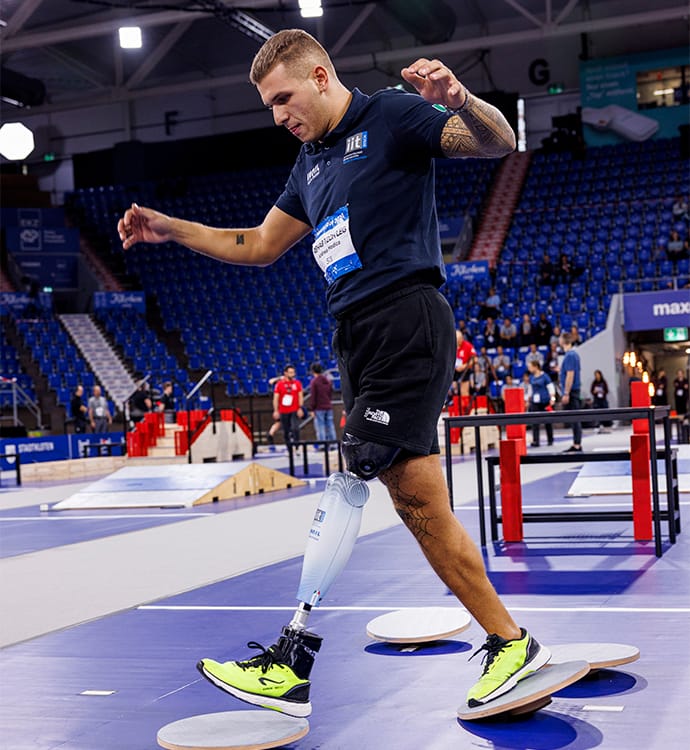
With a wrench in hand, Andrea Modica makes a final adjustment to the gleaming metallic joint on the prosthetic leg strapped to his left thigh. He stands and walks a few steps along the neon-lit corridors at the Italian Institute of Technology (IIT) in Genoa, Italy. Moments later, he re-enters the laboratory with a thumbs-up. “That’s much better,” he said.

Modica is the pilot and mechanic of the lower limb prototypes developed by the IIT in collaboration with the INAIL Prosthetics Center. These powered prosthetic legs are designed to work in harmony with the body’s natural mechanics.
In 2011, then 20 years old, Modica lost his left leg in a motorcycle accident. Today, he is the human center of a sophisticated feedback loop, a living bridge between the world of algorithms and the feeling of a foot planting firmly on uneven ground. He understands the daily frustrations, the specific needs, and the feel of a prosthesis in a way no nonamputee engineer ever could, Nicolò Boccardo, PhD, chief mechatronic engineer at the Rehab Technologies Laboratory (IIT) in Genoa, Italy, told Medscape News Europe.
Researchers are advancing prosthetics, from replacing a limb to constructing a machine that responds as fluidly and intuitively as flesh and bone. The dream, as Modica puts it, is “of a prosthesis that is not just attached to the body but is truly a part of it.”
From Passive Tool to Powered Partner
Traditional passive prosthetics are purely mechanical; they are artificial limbs that rely on the user’s body weight to store and release energy. Today, even the most advanced devices are quasi-passive and use a microprocessor to control a hydraulic damper. This system provides resistance for stability, preventing stumbles and allowing for controlled descent on stairs and ramps. However, these devices are still energetically passive. They cannot add power.

This passivity has direct, long-term clinical consequences, Boccardo said. The user must compensate by using their hip and back to swing the leg, causing an unnatural strain. “[People] begin to develop compensatory movements which, in the long run, lead to complications like back pain or contribute to the generation of neuropathies [and] inflammation in the lumbar region,” he said.
The alternative, fully powered prostheses, present their own problems: These are often much heavier, noisier, bulkier, and have a shorter battery life.
Researchers at IIT have developed a semi-powered or hybrid device. It is designed to provide power only when necessary. It combines two technologies: a quiet and reliable microprocessor-controlled hydraulic damper to be used in passive activities and an electric actuator that a patient can use on-demand to support power-demanding tasks.
Boccardo said it’s an approach similar to the e-bike concept. “It gives an active contribution, a little push,” he said. This burst of power is explicitly applied during tasks that require extra energy, such as climbing stairs or standing up from a chair, which are the very moments when passive devices struggle.
The Human-Centric Challenge
While powered components are solving physical challenges, other important factors are the interface with the residual limb and intuitive control. “You can have the best powered knee, but if the socket is not fitting well, your benefit will be limited,” said Asgeir Alexandersson, MD, the director of neuromuscular technology at Össur, an Icelandic company headquartered in Reykjavik, Iceland, that develops and manufactures prosthetics.
The challenge of intuitive control becomes even more important in upper-limb prosthetics. The motion of a lower-limb prosthesis is largely repetitive. “A lot of the stuff we do with a lower limb is cyclical, like walking,” Alexandersson explained. A knee’s control system can be primarily reactive, using internal sensors to identify the phase of the gait cycle. In contrast, the intended motion of an upper-limb prosthesis is almost never cyclical, he explained. “The actions are usually quite unique every time.” A hand must be able to understand the user’s specific intent — whether to pick up an egg, turn a key, or zip a jacket. “The challenge for the last decades has mainly not been related to the prosthetic hardware of the hand,” Alexandersson said. “It’s more about: How do you actually control it?”
Conventional myoelectric prosthetics use sensors (electrodes) placed on the skin to “listen” to the tiny electrical signals from muscle contractions in the residual limb and then transform these signals into movement of the prosthesis, Alexandersson said. But this approach has clinical limitations. Traditional myoelectric systems are “not very intuitive and can place a high cognitive demand on the user, which contributes to a high rate of abandonment.”
Part of the problem stems from the use of surface sensors, which are sensitive to placement on the skin and can be affected by factors such as movement and sweat. Furthermore, surface sensors can simultaneously pick up signals from multiple muscles — making the message noisy — and mostly those in the superficial layers.
One possible solution is to place sensors inside the muscles. This provides an “extremely stable signal,” Alexandersson said, which allows for fine, intuitive control and dramatically lowers the cognitive load. The Implantable Myoelectric Sensor system developed by Össur in collaboration with California-based huMannity Medtec is now being tested on two people with below-elbow amputations who have received the implants.
The Next Frontier: Artificial Intelligence (AI)
Another solution might be to use large matrices of sensors that read the subtle patterns of muscle contractions across the entire residual limb, Boccardo explained. AI algorithms then learn and anticipate the user’s intentions. “That’s where we may see big improvements,” said Alexandersson. But he cautioned that the performance of AI algorithms depends on the quality of data used.
For Modica, who won first place at the Cybathlon 2024 in Switzerland using the Omnia prototype, intuitive control is the final piece of the puzzle. It’s the “key to closing the loop, which will transform the prosthesis from a tool to be operated into an extension of the self.”
Modica and Boccardo reported no relevant financial relationships.
Alexandersson is the director of neuromuscular technology at Össur.
Manuela Callari is a freelance science journalist specializing in human and planetary health. Her work has been published in The Medical Republic, Rare Disease Advisor, New Scientist, The Guardian, MIT Technology Review, and others.
