Admin_Adham
 Jump to Key Points
Eventually, every doctor becomes a patient. For many physicians, experiencing serious illness and treatment is humbling, eye-opening, and, in the end, transformative. Dr. Patient is a Medscape series telling these stories.
I was a first-year anesthesiology resident at the University of Pennsylvania in Philadelphia when I developed an unusual sensation in my chest. I can only describe it as “sloshing.” It was most pronounced when I would turn over on my side while sleeping. After a few days of this, I asked my then boyfriend Vincent, who was an internal medicine resident at Penn, to auscultate me.
We were sitting on the couch at home. After listening to the right side of my chest, he took the stethoscope down from his ears and looked at me. “I don’t hear any breath sounds on the right side.”
You don’t have to be a doctor to know that’s not a good sign.
- LAM: rare progressive cystic lung dz; predominates in premenopausal women.
- Presentation: unilateral pleural effusion + complete hemithorax opacification; thoracentesis drained >2 L.
- CT: innumerable cystic lung lesions; radiology favored probable LAM.
- Sirolimus = only FDA-approved LAM therapy; disease-modifying, slows cystic/lymphatic progression.
- Fertility/pregnancy decisions required individualized risk-benefit; surrogacy used after IVF/embryo freezing.
“You really should get a chest x-ray,” he said, so he put in the order himself.
The next day, I went to work as usual. In between cases, I ran down to radiology and got the chest x-ray taken. Then I went back upstairs to an empty operating room and did the thing you’re not supposed to do: I pulled up my own chart.
The entire right side of my chest was whited out — complete opacification of my right hemithorax. I called Vincent and said, “I think I have lymphoma.”
Vincent was rotating in the medical ICU at the time, and he showed my x-ray to his attending, who said, “She needs to get thoracentesis. And she needs a chest CT.” Those things happened in rapid succession. We drained over 2 L of fluid from the right side of my chest.
When we got the CT findings, Vincent and I were sitting on bar stools together at our kitchen counter. The images looked like lace. There were innumerable cystic lesions in my lung parenchyma. The radiologist’s report said probable lymphangioleiomyomatosis (LAM).
I had never heard of it, but Vincent had. He just looked at me. My stomach dropped. It’s a very rare lung disease, he explained, which almost exclusively affects women, particularly premenopausal women.
“There’s no cure,” he said. “It’s progressive.” And then he just stopped talking.
It was one of those out-of-body experiences. I was watching this happen, and I thought, I should be panicking. I should be hysterical or crying. Instead, I felt this overwhelming sense of calm. I recognized that feeling.
It was Thanksgiving. I was 8 years old, and I found my maternal grandfather choking on the living room floor in our home. I remember thinking his skin looked all wrong and the gurgling sound he was making wasn’t normal either. I went to get my mom, who got my dad, and he sprang into action.
My father was a cardiac surgeon, but to me, he was just Dad. I had never seen him as Dr Hoy, someone who could take control of a chaotic situation with such urgency and calm.
I remember thinking that this should be a panicked moment, watching my father do an emergency tracheostomy on my grandfather with a kitchen knife. But it wasn’t. His years of training and experience gave him composure and the ability to act when everyone else was paralyzed with fear.
It had an enormous impact on me and shaped my earliest understanding of what being a physician meant: When the unimaginable happens, you can stay calm because you know what to do.
It was strange having that memory collide with this very different crisis, decades later.
I took a week off in the immediate aftermath. We had to find a way to mitigate the constant re-accumulation of lymphatic fluid in my right chest. I had a semipermanent catheter inserted between my ribs, so I could drain the fluid myself while at home or at work, which I had to do for almost 3 months.
In between cases, I would wheel my patient out of the operating room, push the heavy gurney, go to the bathroom and empty the lymphatic fluid coming out of my chest, and then go and get my next patient. It was incredibly painful, both physically and emotionally.
I was at the beginning of my residency, learning how to be a physician while also learning how to be a patient. I was experiencing how it felt to lose my own air while learning how to keep others breathing.
There were some really hard moments. I cared for other women coming in for lung transplants, and all I could think was: This could be me one day.
While we were managing the fluid, we were also starting me on a medication called sirolimus, an mTOR inhibitor and the only FDA-approved medication for LAM. It’s a disease-modifying therapy, not a cure. But it can slow the progression of the cystic lung destruction and slow the lymphatic complications. If it were not for that medication and the expertise of my LAM physician at Penn, my course in those initial months would have been much worse. Over time, I have come to understand just how fortunate I was.
There’s life before your diagnosis, and then there’s life after. Vincent and I had been dating for less than a year at this point. I now joke that if you want to know if a man is serious about you, get diagnosed with a rare, progressive, potentially life-limiting condition at 28, and ask him, “Do you want to make embryos with me?”
I was suddenly confronted with the issue of fertility. LAM progression is strongly influenced by hormones. In the weeks after my diagnosis, I realized: My lungs are never going to be healthier than they are right now. My eggs are never going to be more viable than they are right now. If I want the possibility of having a family, we need to do it now.
Without hesitation, Vincent wanted to move forward with me.
One of the many challenges of rare disease, particularly when it intersects with women’s health, is the lack of evidence. So much of what we have to go on is based on expert opinion instead of data. So it quickly became a very personal risk-benefit calculus.
Could I safely become a mother? Would getting pregnant mean that I would destroy my lungs in the process? How could I do that to Vincent, to my family? Ultimately, it became a question of: what can I live with?
As an anesthesiologist, hardwired to always be prepared with contingency plans, the sense of building the plane as you’re flying it and simply hoping for the best is destabilizing.
We decided to do one round of in vitro fertilization. The outcome was not particularly good. We froze only two embryos. But we were not willing to do more without knowing what the hormonal treatment would do to my lungs. We put the two embryos in the freezer and tried to return to our lives.
Three years later, in 2016, we got married.
It wasn’t until May of 2020 that my dad asked, “So what are you going to do with those embryos?”
I said, “Well, there happens to be a global viral respiratory pandemic going on.”
We did heed my father’s prodding, though. I knew that I would never be comfortable becoming pregnant myself. Surrogacy became the path that felt safest.
The embryo that we transferred to our gestational carrier was over 8 years old. There’s no way this is going to work out, I thought.
But it did. We had the most heart-rending, extraordinary experience with surrogacy. Both the pregnancy and delivery were seamless. And we now have a 4-year-old boy. I still think about the improbable path we took that led to him, contoured with uncertainty and grief, but now so much joy.
There’s heartbreak there, too. Our carrier agreed to carry for us again. But our second embryo didn’t result in a successful pregnancy. So loss is part of our story, too.
Living with a rare disease is like that.
During COVID, I eventually fully stepped away from patient care. I had been experiencing lung function decline, and the mTOR inhibitor has immunosuppressing effects. Leaving clinical medicine was not a simple or easy decision, and I carry grief about that particular loss of identity.
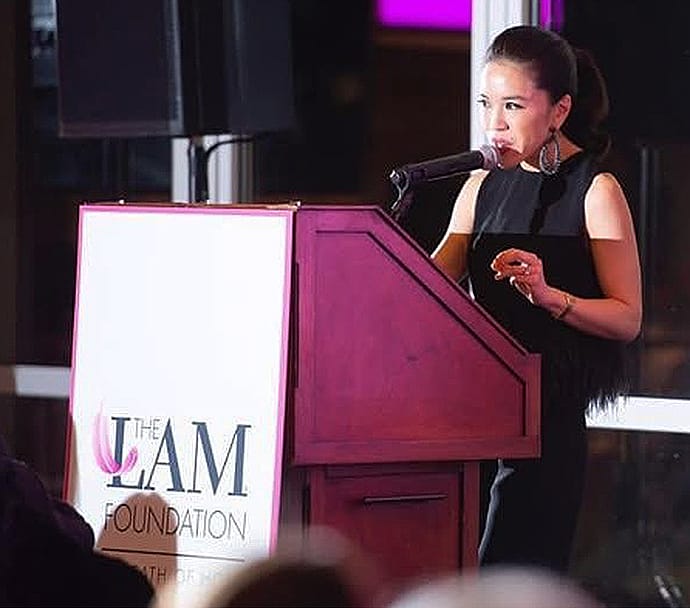
In 2022, I joined the board of directors of The LAM Foundation. Over time, my involvement grew into a focus on research strategy, patient advocacy, clinical partnerships, and bringing rare diseases more fully into conversations about women’s health. I have come to know other women with LAM across the country and around the world. Some have had access to the level of expertise and care that I had. Others have not. It has changed my thinking about what it means to help someone as a physician.
When I was in medical school thinking, what kind of doctor do I want to be, I wanted clarity in a crisis. I still see this as extraordinary. But having lived on both sides of medicine and looking at healthcare through a very different lens, I’ve realized the harder work, in many ways, comes after or in between the crises. I’m driven now to identify the gaps and uncertainties and work to champion those whose needs remain invisible.
I don’t believe that everything happens for a reason. I know bad things happen all the time for no reason at all. LAM has taken things from me that I wish I hadn’t lost. More than anything, though, I hold on to gratitude — that I am alive, that I became a mother, that I am still here — and the humility, reflecting on what could have been.
Lyndsay Hoy, MD, is a physician and anesthesiologist by training, and Vice Chair, Strategy and Mission, on The LAM Foundation Board of Directors.
Are you a doctor with a dramatic story about life as a patient? Medscape would love to consider your story for Dr. Patient. Please email your contact information and a short summary to access@webmd.net.
The expert cited in this article had no relevant disclosures.