

 Admin_Adham
Physician Assistant Workforce Sees Ongoing Growth
A new report finds that the physician assistant (PA) profession continues to accelerate nationwide, with the number of certified assistants/associates in the United States growing by 28% from 2018 to 2022.
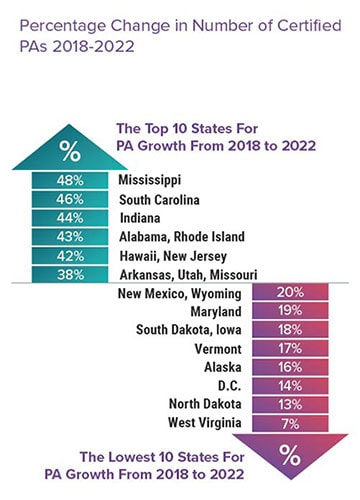
Board-certified PAs increased from 40 to 50 per 100,000 population during the 4-year period, according to the analysis by the National Commission on Certification of Physician Assistants (NCCPA). Mississippi, South Carolina, and Indiana were among the top states for PA growth, while West Virginia, North Dakota, and the District of Columbia experienced the smallest increases.
The growth is encouraging, particularly in the Southeast where PA progress has historically lagged behind the rest of the country, said Jonathan Baird, DMSc, PA-C, an assistant professor in the Master of Physician Assistant Studies Program at Rocky Mountain University in Provo, Utah, and Utah Delegate to the American Academy of Physician Assistants (AAPA).
"Overall, to have the type of growth we've had since 2018, you've got to really feel positive about that if you're a member of the profession," Baird told Medscape Medical News. "This is a profession that has a strong foundation, and it's growing because it's needed."
Telemedicine Soars Among PAs
PAs are also using telemedicine at record rates, the NCCPA report found. Telemedicine participation by PAs surged from 9% in 2018 to 40% in 2022. Alaska, by far, leads the charge in telemedicine adoption with 59% of PAs leveraging virtual care there, followed by 55% of PAs in Hawaii, and 54% of PAs in Oregon, according to the study.
Higher telemedicine adoption by Alaskan PAs was largely driven by a 2022 telehealth law that allowed medical practitioners to provide healthcare without in-person visits, said Betsy Douds-Paczan, MPAS, PA-C, president of the Alaska Academy of Physician Assistants. The law also enables patients throughout Alaska to receive care more easily from both in-state providers and out-of-state specialists, Douds-Paczan said in an interview.
She noted that less than 10% of Alaska is accessible by road, and more than 20% of Alaskan residents live in rural or remote locations.
"Telemedicine allows many of those people to receive care that they might not seek or have access to otherwise," she said. "Alaska is, by necessity, at the forefront of the development of telemedicine, and the growing population of physician assistants will naturally continue to integrate it into their practices."
A Female-Dominated Industry
The PA profession remains largely women, a trend that has held steady over the past decade. PAs were 71% women in 2022 and 29% men, with about the same split in 2018, according to NCCPA data.
In general, the field has undergone a "complete 180" in gender makeup since its early establishment, when men outnumbered women, Baird said. Past data show the gender gap equalized in the mid-1990s and started moving in the opposite direction in the early 2000s.
In 1995, for example, 53% of PAs were men and 47% were women, according to a report by the AAPA. In 2004, the split was 60% women and 40% men, according to a subsequent AAPA report. In 2014, the first year the NCCPA started publishing annual reports, the gender breakdown was 66% women and 33% men, according to 2013 data.
The gender shift is likely due to the profession's attributes, such as flexibility and work-life balance, according to past literature, said Andrzej Kozikowski, PhD, NCCPA Senior Director of Research at the National Commission on Certification of Physician Assistants. However, Kozikowski noted that more research is needed to better understand the decline of men in the PA field.
Baird wonders how the ongoing decline of male PAs may ultimately affect patients. A diverse mix of PAs is beneficial, especially considering that male patients tend to seek healthcare less often than female patients, he noted.
"One of the things that we know from the literature is that people tend to favor a medical provider that is like them," Baird said. "Usually, that's brought up in the context of ethnicity, but the same holds true for gender. And so, whereas we have a segment of the population that tends not to seek healthcare, will this shift end up exacerbating the fact that men don't seek more healthcare? That's the question that's in my mind."
Most PAs Are 'Satisfied' With Their Career, Income
PAs are making more money than in the past, a factor that contributes to high satisfaction, the NCCPA report found. The mean income for PAs in the United States rose from $110,599 in 2018 to $120,204 in 2022.
California PAs had the highest mean income in 2022 at $138,422, followed by Nevada PAs at $133,678 and Connecticut PAs at $131,878. Meanwhile, Pennsylvania, Alabama, and Kentucky had the lowest mean incomes, ranging from $110,000 to $111,000.
Kozikowski of NCCPA said that supply and demand, as well as inflation are likely drivers for the income increase.
Medscape Medical News' 2023 Physician Assistant Compensation Report found slightly higher incomes for PAs in 2022, with average total compensation reported at $134,000. (Medscape Medical News' report included base compensation, incentive pay, bonuses, and other factors.)
Three quarters of PAs listed "income" as an area of job satisfaction. Other highly ranked areas of satisfaction included, work-life balance (71%), number of hours worked (77%), and benefits (73%). The mean number of hours worked in 2022 was 40.
About 87% of PAs said they were satisfied with their career, and 84% were satisfied with their present job, according to the report. Oklahoma and Ohio PAs were among the most satisfied with their careers at 91% and 89%, respectively.
The ability to move specializations and participate in various procedures contributes to PA job satisfaction, said Douds-Paczan.
Overall, 54% of PAs have changed specialties at least once, with 23% making two to three specialty switches.
Baird said that switching specialties is a unique part of the PA world and an advantage that rose to the forefront during the pandemic.
"What COVID really showed us is that PAs are able to be nimble and can shift when needed," he said. "We saw many examples of that during the pandemic, and we'll probably see more in the future. As the market dictates where the need is, the help can flow in that direction a little more quickly in the PA workforce."
Alicia Gallegos is a freelance healthcare reporter based in the Midwest.


