
 Admin_Adham
 Jump to Key Points
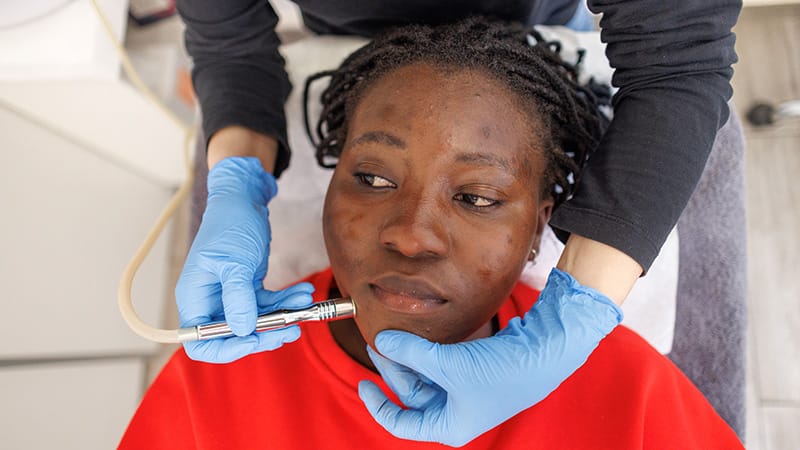
NEW YORK — Within the goal of preventing acne-associated hyperpigmentation, or AAH, an acronym recently proposed to replace what has been called acne-related postinflammatory hyperpigmentation (PIH), new emphasis has been placed on considering acne lesions and AAH as inseparable goals of effective therapy in patients with skin of color.

One reason for the new acronym is a recently published compilation of evidence that PIH in skin of color following acne is an ongoing inflammatory process, not a sequela of inflammation, according to Andrew Alexis, MD, MPH, professor of dermatology at Weill Cornell Medical Center, New York City. Alexis was one of the authors of the Viewpoint paper, published in JAMA Dermatology.
The new acronym also serves the purpose of placing a focus on both acne lesions and the pigmentary changes associated with acne in patients with darker skin types. Clearing acne is not enough, in that avoiding or clearing AAH is also “a top priority for our patients with skin of color,” according to Alexis.
“Patients often come in seeking treatment for the AAH without even mentioning the acne,” said Alexis, speaking at the Skin of Color Update (SOCU) 2026. For those who develop AAH, he added, it is “of at least an equal concern to the acne itself.”
- Acne + AAH/PIH should be treated as inseparable goals in skin of color.
- PIH in acne may reflect ongoing inflammation, not just postinflammatory sequelae.
- Clearance often needs 4–6+ months; 12-week trials may underestimate response time.
- Less-irritating retinoids, fixed combos, moisturizers, sunscreen, depigmenting agents can reduce AAH risk.
- Low threshold for oral/systemic therapy; Black patients may be undertreated.
Clear Skin Takes Longer When AAH Is a Risk
Ultimately, the goal of clearing both acne lesions and AAH in patients with skin of color means a longer course of treatment. Although acne treatment trials typically employ a duration of 12 weeks to demonstrate efficacy, clearing acne and AAH in patients with darker skin types typically requires an extended regimen of multiple therapies, according to Alexis.
“We have to set realistic expectations in our patients with skin of color,” Alexis said. Rather than acne clearance within 2 or 3 months of treatment, 4 to 6 months — or even longer in some cases — is commonly needed to restore darker Fitzpatrick phototypes to normal skin, free of both acne and AAH.
Opportunities for effective treatment of acne in skin of color have improved. Alexis pointed to less irritating retinoids, fixed combinations of drugs addressing acne through multiple pathways, safer depigmenting agents, and better use of moisturizers, sunscreens, and other adjunctive therapies that reduce the risk for inflammation.
Relative to standard retinoids, trifarotene 0.005% cream, tazarotene 0.045% lotion, and tretinoin microsphere gel (available in multiple concentrations) were all identified as less irritating than “classic options” like tretinoin 0.25%–0.05% cream and tazarotene 0.05% cream.
“These are newly designed options to improve tolerability,” said Alexis, citing a phase 4 study of patients aged 17-34 years (not specifically patients with skin of color) with moderate-to-severe facial acne and scarring, which associated trifarotene treatment with a reduction from baseline in atrophic acne scars relative to vehicle.
Fixed dose dual or triple combination topical retinoids and antibiotics are also showing high rates of efficacy while reducing acne scarring, Alexis noted. He cited a study published this year with a gel combining clindamycin phosphate 1.2%, adapalene 0.15%, and benzoyl peroxide 3.1% that provided a significant reduction in acne scarring from baseline (also not specifically patients with skin of color).
Clascoterone May Have Adjunctive Benefit
These combinations offer relatively high rates of efficacy with a low relative risk of inducing AAH, and they can also be the foundation upon which additional therapies can be added to accelerate clearing. As one example, Alexis cited clascoterone cream, a topical antiandrogen medication that targets the sebaceous gland, as an option to boost response. It is not only well-tolerated but appears to have an anti-inflammatory effect by reducing cytokine production, he noted.
With many options now available for the control of acne, he advised clinicians to consider intensifying therapy in cases of a slow response in patients with skin of color. In particular, there should be a “low threshold” for moving to oral therapy. A 2020 study that found non-Hispanic Black patients were less likely to receive oral antibiotics and other systemic treatments than non-Hispanic White patients suggests that acne therapy is not being optimized when needed to achieve clear skin.
The efficacy of oral retinoids and antibiotics, including sarecycline, which produced a high rate of efficacy in the 2024 PROSES study, is not unique to skin of color. But effective options, including procedural treatments, should be offered at least as often and as promptly in patients with skin of color, particularly in the context of the dual goal of clearing lesions and AAH, he said.
Because of the growing array of acne therapies and progress in understanding how adjunctive therapies can improve complete clearance in skin of color, Heather Woolery-Lloyd, MD, director of the Skin of Color Division at the University of Miami, agreed that more patients with darker Fitzpatrick skin types are reaching treatment goals and reaching them faster.
But “quick” in patients of skin of color can be as long as 4 months, she said, “not 1 [month], which is what most patients want.” She agreed that creating realistic expectations about clearing both acne and acne-related discoloration is a first step when embarking on therapy.
Morning and Evening Regimens Recommended

Joining Alexis in a discussion of acne-related hyperpigmentation at the Skin of Color Update, Woolery-Lloyd proposed a comprehensive program divided into morning and evening regimens for facial acne managed with topical therapies.
In the morning, prior to applying anti-acne therapies, often in combination, she recommended a medicated cleanser followed by a full-face depigmenting agent. Although hydroquinone can be considered, she finds herself using less-irritating alternatives, such as thiamidol or 2-mercaptonicotinoyl glycine (2-MNG), more frequently.
Full-face application of the anti-acne topical therapy is then followed by application of a broad spectrum sunscreen that can block the effects of UVA, UVB, and visible light. Combination sunscreens to ensure protection across the harmful light spectrum are an option.
In the evening, the sequence of therapies is repeated with cleansing, a full-face application of a depigmenting agent, and a full-face application of an anti-acne therapy. The final step in the evening, rather than sunscreen, is a moisturizer to help improve skin tone. Woolery-Lloyd suggested niacinamide as an example.
Like Alexis, she emphasized that the options for managing acne in the context of minimizing pigmentary changes have improved. She endorsed the message that selecting therapies with a low risk of inducing AAH is as critical as resolving the pustules, papules, and comedones of acne — and reiterated the concept that treatment is not complete until both acne and AAH are cleared.
“Many patients often tell me that the acne is not the issue,” Woolery-Lloyd said. “It’s the spots [of discoloration] which concern them the most.”
Alexis reported financial relationships with AbbVie, Allergan Almirall, Alphyn Biologics, Alumis, Amgen, Apogee, Arcutis, Boehringer Ingelheim, Botanix, Bristol-Myers Squibb, Canfield, Castle Biosciences, Dermavant, Genentech, HairDays, Incyte, Johnson & Johnson, Leo Pharma, Lilly, L’Oreal, Novartis, Ortho Dermatologics, Oruka, Pfizer, Sanofi-Regeneron, Swiss American, Symrise, UCB, Veradermics, and VisualDx.
Woolery-Lloyd reported financial relationships with AbbVie, Allergan, Arcutis, AViTA, Beiersdorf, Eirion, Estee Lauder, Galderma, Incyte, Johnson & Johnson, Kymera, L’Oreal, Nutrafol, Nordberg, Ortho, Pfizer, Regeneron, and Unilever.
Ted Bosworth, a career medical writer based in New York City, has been covering advances in clinical medicine, including dermatology and oncology, for several decades.