Admin_Adham
TOPLINE:
In individuals with medial compartment knee osteoarthritis (OA), personalized foot progression angle modifications led to greater reductions in medial knee pain and the knee adduction moment peak than sham gait retraining after 1 year and showed promise in slowing cartilage degeneration.
METHODOLOGY:
- Researchers conducted a randomized controlled trial at Stanford University (August 2016-June 2019) and compared the efficacy of personalized foot progression angle modifications with sham gait retraining in individuals with medial knee OA.
- They included 68 participants (mean age, 64.4 years; 60% women; 79% White) with medial compartment knee OA grades 1-3 on the Kellgren-Lawrence scale, medial knee pain of 3 points or more on a numeric rating scale, an ability to walk safely on a treadmill for 25 minutes, and a BMI < 35.
- Participants were randomly assigned to either the intervention group (n = 34) or the sham group (n = 34), with the intervention group receiving personalized foot progression angle modifications.
- Participants practiced natural walking on a treadmill, with vibrotactile feedback for toe-in and toe-out. During the foot progression angle personalization visit, they completed a walking trial, followed by four angle-evaluation trials, with feedback given for 5° and 10° of toe-in and toe-out. They received biofeedback during six gait retraining visits. The sham group’s target was their natural foot progression angle from week 0.
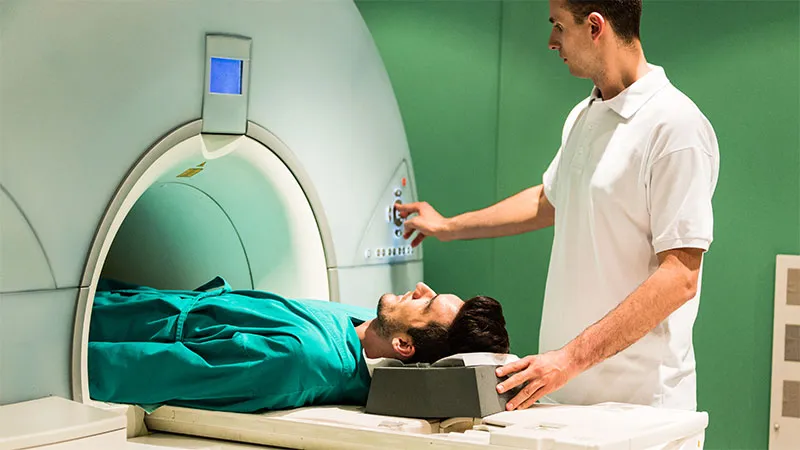
- Primary outcomes were changes in medial knee pain on the numeric rating scale and the knee adduction moment peak over 1 year. Secondary outcomes were changes in cartilage microstructure assessed using MRI (T1rho and T2 relaxation times), and safety assessed by recording adverse events.
TAKEAWAY:
- The intervention group experienced a greater reduction in numeric rating scale medial knee pain than the sham group at 1 year (difference, -1.2; P = .0013).
- The reduction in the knee adduction moment peak from personalization visit to year 1 was -0.17 % bodyweight × height for the intervention group, with a between-group difference of -0.26 (P = .0001).
- MRI results indicated that the intervention group had less increase in T1rho relaxation times in the medial weight-bearing femoral cartilage than the sham group (between-group difference, -3.74 ms; 95% CI, -6.42 to -1.05), suggesting slowed cartilage degeneration in the intervention group.
- Two participants in the intervention group dropped out due to increased pain — one in the medial compartment and one in the patellofemoral compartment — and one participant in the sham group withdrew because of increased medial knee pain.
IN PRACTICE:
“[The study] findings highlight the potential of personalized gait retraining to become an effective conservative intervention for medial knee osteoarthritis,” the authors of the study wrote.
SOURCE:
This study was led by Scott D. Uhlrich, PhD, and Valentina Mazzoli, PhD, Musculoskeletal Research Laboratory, Veterans Affairs Palo Alto Healthcare System, Palo Alto, California. It was published online on August 12, 2025, in The Lancet Rheumatology.
LIMITATIONS:
Investigators were not masked during gait retraining visits, and pain scores were collected by unmasked staff, potentially introducing bias in outcome assessment. The high number of lab visits and disruptions caused by the COVID-19 pandemic led to incomplete data. The exclusion of individuals with a BMI > 35 and those with severe OA may limit generalizability.
DISCLOSURES:
This study was supported by the US Department of Veterans Affairs and the US National Institutes of Health. One author reported being supported by fellowships from the National Science Foundation and the Stanford Office of the Vice Provost for Graduate Education. The authors declared having no conflicts of interest.
This article was created using several editorial tools, including AI, as part of the process. Human editors reviewed this content before publication.