
 Admin_Adham
 Jump to Key Points
SAN DIEGO — Transcatheter aortic valve replacement (TAVR) in older patients with moderate aortic stenosis (AS) reduced cardiovascular events and improved quality of life over a 2-year follow-up in a new multicenter randomized trial. There is currently no indication for valve replacement in such patients.
“These data establish that moderate AS is not benign and that symptomatic patients with risk factors should be referred to a valve clinic than waiting for progression to intervene,” reported Philippe Généreux, MD, interventional cardiologist affiliated with Atlantic Health Morristown Medical Center in Morristown, New Jersey.
At 2 years, the primary endpoint of all-cause death or heart failure event was reached by 16.7% of those randomly assigned to TAVR and 23.9% of those randomly assigned to clinical surveillance in this open-label study, Généreux said. The absolute 7.2% risk reduction was statistically significant (P = .02).
Complications related to TAVR measured with a composite safety endpoint at 30 days occurred at a rate far below the predefined performance goal, Généreux said.
- PROGRESS: TAVR in moderate AS + risk features ↓ 2-year death/HF events vs surveillance.
- Primary endpoint: 16.7% TAVR vs 23.9% surveillance; absolute risk reduction 7.2%.
- HF events ↓ ~45%; HF hospitalizations ↓ ~50% with TAVR.
- KCCQ improved 15.3 points at 30 days after TAVR; surveillance unchanged.
- 30-day TAVR safety endpoint 5.9%, below 13.7% performance goal.
Evidence Met With Enthusiasm
When the primary outcome slide was presented at a late-breaker session of Transcatheter Cardiovascular Therapeutics (TCT) 2026, it received prolonged applause from an interventionalist audience welcoming evidence that earlier intervention in AS offers objective clinical benefits.
The study, called PROGRESS and conducted at 74 sites in six countries, was published simultaneously in The New England Journal of Medicine.
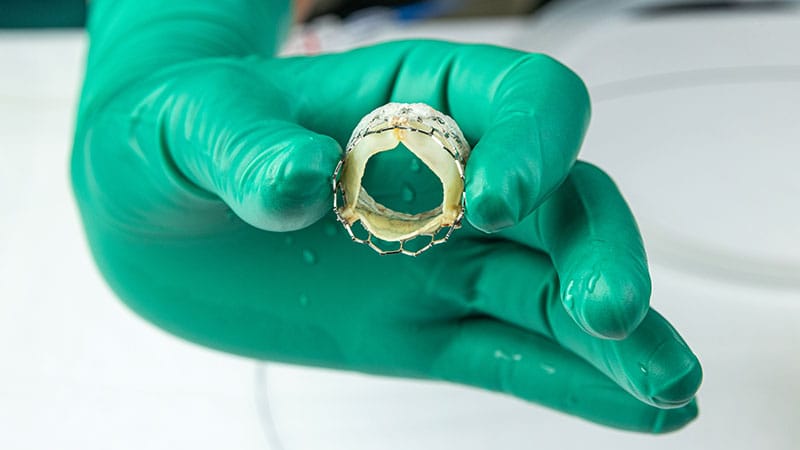
In this study, 744 patients aged 65 years or older with moderate AS by echocardiographic assessment and at least one at-risk feature were randomized. The study arms were guideline-recommended clinical surveillance or transfemoral placement of one of three models of a balloon-expandable TAVR device (Sapien 3, Sapien 3 Ultra, or Sapien 3 Ultra RESILIA; Edwards Lifesciences).
The at-risk features that conferred study eligibility included class 2 or higher heart failure, left ventricular ejection fraction of less than 60% (but not < 20%), or grade 2 or higher diastolic dysfunction. Subjects were not eligible if they had untreated coronary artery disease requiring revascularization.
When the components of the primary endpoint were assessed individually, the numerically higher rate of death from any cause at 2 years in the TAVR group than in the surveillance group (8.4% vs 7.3%) was not statistically different.
For a composite secondary endpoint of death, stroke, or hospitalization at 2 years, the numerical advantage of the TAVR group (17.7% vs 23.3%) fell just short of statistical significance (P = .07).
Ultimately, the reductions in heart failure events and the improvement in quality of life represented by far the most significant advantages at 2 years.
All three criteria for a heart failure event — one new or worsening symptom, evidence of decompensation on at least two objective assessments, and need for at least one heart failure treatment — were required to constitute a heart failure event. These occurred at a rate about 45% lower in the TAVR arm (10.8% vs 19.0%; P = .002).
As an isolated outcome, heart failure hospitalizations were about 50% lower in the TAVR arm (7.4% vs 14.9%; P < .001).
Quality of Life
Quality of life as measured with the Kansas City Cardiomyopathy Questionnaire (KCCQ) improved directly after TAVR. Compared with no appreciable change in the surveillance group, the mean KCCQ score at 30 days climbed 15.3 points from baseline (79.6 vs 64.3), where 5 points is generally accepted as clinically meaningful.
The components of the composite safety endpoint at 30 days were death, stroke, life-threatening bleeding, stage 4 acute kidney injury, hospitalization for a procedural or device-related complication, and valve dysfunction leading to reintervention.
The predefined performance goal for this safety outcome was 13.7%.
Upon calculation of the 97.5% CI for the 5.9% rate of safety events in the TAVR arm at 30 days, the 8.8% upper limit fell below the performance goal at a highly statistically significant margin (P < .0001).
In the surveillance arm, 204 patients (57.4%) underwent aortic valve replacement during the 2-year follow-up. Of these, 81% had progressed sufficiently to meet a class I indication for replacement on the basis of the joint American College of Cardiology/American Heart Association guidelines. From randomization to the time of aortic valve replacement in the surveillance arm, the mean reduction in the KCCQ score was 9.3 points. About 30 days after replacement, the KCCQ score increased 22.3 points.
“To me, a substantial clinical benefit with no safety issue related to the procedure makes these results impressive,” said Roxana Mehran, MD, director of the Interventional Cardiovascular Research and Clinical Trials section of the Zena and Michael A. Wiener Cardiovascular Institute at the Icahn School of Medicine at Mount Sinai in New York City.
She does consider the lack of a surgical repair (SAVR) arm a “missing piece” from this study, even if she would have expected the same result at 2 years regardless of the method of valve repair. Still, an arm with which to compare SAVR to TAVR over long-term follow-up — planned follow-up is 10 years — would have been “useful,” Mehran said.
Mehran also said she is looking forward to more data to corroborate the benefits seen in this study.
“Were these results to change guidelines — I do not know if they will — it is so very, very important to have real-world evidence and long-term follow-up to be sure,” she added.
The fact that the major benefit of this trial was measured as a reduction in hospitalizations and an improvement in quality of life rather than in harder events did not diminish the enthusiasm of the TCT-invited discussant, Stephan Windecker, MD, PhD, chairman of the Department of Cardiology at the University of Bern in Bern, Switzerland.
“This is a landmark study in that it showed clinically meaningful benefits but achieved the safety performance goal by a larger margin,” Windecker said.
A late-breaker session panelist, Patrick T. O’Gara, MD, director of Strategic Planning for the Cardiovascular Division of Mass General Brigham in Boston, suggested that these data are relevant mainly to the symptomatic older patients who were enrolled in this study, but the reduction in heart failure hospitalizations and improvement in quality of life provide solid indications for this intervention.
“It is very important to make these patients feel better,” he said, noting that this is their primary motivation for consulting with a physician. In the context of the safety of TAVR in this trial, “this is a very good outcome,” he added.
Généreux reported having a potential financial relationship with Edwards Lifesciences, which provided funding for the PROGRESS trial. Mehran reported having financial relationships with Abbott, Affluent, Alleviant Medical, Chiesi Farmaceutici, Concept Medical, Cordis, CPC Clinical Research, Daiichi Sankyo, Duke, Esperion Science/Innovative Biopharma, Faraday Pharmaceuticals, Idorsia Pharmaceuticals, Janssen Pharmaceuticals, MedAlliance, Medtronic, New Amsterdam Pharma, Novartis, and Novo Nordisk. O’Gara reported having no potential conflicts of interest.
Windecker reported having financial relationships with Abiomed, Amgen, AstraZeneca, Bayer AG, B. Braun, Biotronik, Boehringer Ingelheim, Boston Scientific Corporation, Bristol Myers Squibb, Cordis, CorFlow Therapeutics, CSL Behring, Daiichi Sankyo/Eli Lilly, Edwards Lifesciences, Fumedica, Guerbet, Janssen Pharmaceuticals, Johnson & Johnson, MedAlliance, Medtronic, Novartis, Pfizer, Sanofi Aventis, Servier, Sinomed, and V-Wave.
Ted Bosworth, a career medical writer based in New York City, has been covering advances in clinical medicine, including cardiology, for several decades.